Separation Beyond Divorce: Moral Fragmentation and Social Anxiety in A Separation
Asghar Farhadi’s masterpiece turns divorce into a metaphor for ideological fracture, moral ambiguity, and emotional suffocation.
# A Separation: Original Essay: ## Separation Beyond Divorce: Moral Fragmentation and Social Anxiety in Asghar Farhadi’s A Separation
There are films that feel written.
And then there are films that feel observed.
A Separation belongs to the second category.
The film does not move like conventional drama. It moves like life itself — fragmented, morally unstable, emotionally contradictory, and painfully unresolved. What initially appears to be a simple divorce narrative gradually unfolds into something far more devastating: a study of separation as a permanent condition embedded within modern existence.
A Separation is an emotional masterpiece by Asghar Farhadi. The title itself is deliberately provocative about the central theme of the film, which deals with complex and dynamic relationships between its characters. On the surface, the story concerns a couple seeking a divorce due to irreconcilable differences, but as the plot progresses, the emotional and ideological fractures deepen.
Underneath this obvious narrative lies the subtle separation between social classes, the separation of interests, the separation of beliefs ranging from conservative religious fundamentalism to comparatively liberal worldviews, and ultimately the separation between a husband and wife whose conflict transforms from something ordinary into something emotionally catastrophic.
The film reaches its emotional climax when the burden of choosing between parents is transferred onto their daughter, Termeh, as demanded by the law.
And suddenly, divorce no longer feels like paperwork.
It feels like inheritance.
The Institutional Gaze
The opening scene immediately establishes the rules of the world the film inhabits.
The movie begins with a copy machine scanning the passports of Nader and Simin. Instantly, the fourth wall is disrupted as the audience occupies the perspective of the judge facing the couple. The slightly elevated camera angle places viewers within the institutional gaze of authority itself.
This choice is brilliant because Farhadi implicates the audience immediately.
We are not passive observers.
We become participants in judgment.
The tension during this sequence subtly introduces the dynamics of marriage and gender relations within Iranian society. Nader refuses to leave Iran because he cannot abandon his father, who suffers from Alzheimer’s disease, whereas Simin wishes to leave because she believes Iran’s oppressive environment is not suitable for raising their daughter.
Yet Farhadi refuses simplistic moral alignment.
The camera does not privilege either perspective emotionally. Instead, the scene forces viewers into an unstable position where empathy constantly shifts between characters.
This becomes the film’s central mechanism:
conflict without moral clarity.
Conflict as Social Structure
Through the opening conversation, Farhadi introduces what becomes the engine of the entire narrative: conflict of interests.
But these conflicts never exist in isolation.
Every argument emerges from larger political, religious, economic, and social systems operating invisibly within ordinary life.
Farhadi constructs a deeply layered narrative built upon fragile human relationships. His pacing remains restrained, allowing characters enough space to establish emotional complexity and moral ambiguity. Even though the ending remains open-ended, the sequence of events unfolds with painful realism.
Conversations frequently shift allegiance from one character to another, forcing viewers to constantly renegotiate their emotional loyalties.
This narrative instability is reinforced by Aarón Rodríguez Serrano’s discussion of Farhadi’s storytelling structure. Serrano argues that Farhadi deliberately rejects simplistic closure and instead exposes the gap between narrative expectation and the impossibility of moral certainty.
Unlike conventional dramas that resolve ethical tensions neatly, A Separation traps its audience inside uncertainty.
Truth itself becomes unstable.
Polyphony and Moral Ambiguity
The film’s polyphonic structure strengthens this effect even further.
Different perspectives continuously reshape the audience’s understanding of events. The story shifts between Nader, Simin, Termeh, Razieh, and Hojjat, allowing each character’s motivations to appear emotionally justified from within their own worldview.
Importantly, the audience never possesses complete information.
We learn only what characters reveal, conceal, misunderstand, or repress.
Joodaki and Eskandarzadeh describe this structure as fundamentally “polyphonic,” where multiple moral voices coexist without any singular authority fully resolving them.
This limited perspective becomes one of the film’s most psychologically devastating techniques.
Nader repeatedly attempts to teach Termeh the value of honesty and integrity. In one scene, he encourages her to prioritize truth even if it costs her academic marks. Yet later in the film, Termeh is forced into lying before the judge in order to protect her father.
Her moral corruption is not presented as personal failure.
It is presented as inheritance.
She learns that survival within social systems often demands compromise long before adulthood arrives.
Narrative Holes and Psychological Anxiety
Farhadi’s cinema is obsessed with what Serrano calls “narrative holes” — missing information, unseen actions, fragmented truths, and unresolved causalities.
The audience constantly questions what they have or have not witnessed.
Did Nader know Razieh was pregnant? Did Razieh actually steal the money? Was the miscarriage caused by the confrontation?
These ambiguities transform viewers into moral participants rather than passive spectators.
The audience becomes psychologically trapped inside the same uncertainty consuming the characters themselves.
And this is where the film becomes quietly terrifying.
Not because it presents evil people.
But because it presents ordinary people collapsing under pressure.
The Domino Effect of Conflict
Another remarkable aspect of the film is how every conflict contaminates another.
The conflict between Simin and Nader intensifies Nader’s frustration toward Razieh. The conflict between Nader and Razieh leads to accusations of murder following her miscarriage. This generates legal, financial, religious, and emotional crises that continue spiraling outward.
Nothing remains isolated.
Every action creates another fracture.
Farhadi’s realism emerges precisely from this accumulation of consequences. Life in the film feels dense because every character carries invisible pressures simultaneously — economic instability, caregiving exhaustion, religious guilt, gender expectations, legal bureaucracy, and emotional repression.
Conflict here is not spectacle.
It is atmosphere.
Claustrophobia and Visual Separation
The cinematography contributes heavily to the film’s realism and emotional suffocation.
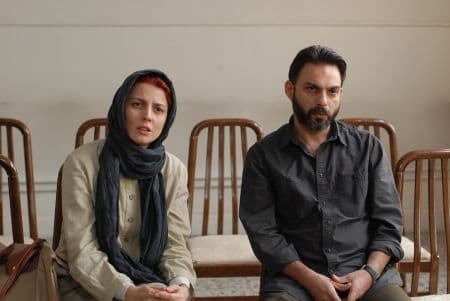
Farhadi frequently employs tight framing, still shots, and claustrophobic interior spaces. Characters rarely share comfortable spatial harmony within the frame. Even when physically together, emotional separation dominates the visual composition.
The camera lingers intensely on facial expressions, capturing suppressed anxiety, guilt, shame, and exhaustion.
One of the film’s most subtle visual metaphors occurs during the hospital elevator scene. As Simin and Nader descend downward, the movement mirrors their increasing descent into emotional and moral crisis.
Farhadi repeatedly frames characters behind glass, curtains, doorways, and architectural obstructions. These visual barriers create a persistent sense of filtered perception.
Reality itself feels obstructed.
The audience never accesses truth directly.
Everything arrives mediated through uncertainty.
Termeh, in particular, is often filmed through reflective surfaces and partitions, emphasizing her emotional isolation. The increasingly claustrophobic framing throughout the film produces an atmosphere where every character appears trapped for different reasons:
- trapped by religion,
- trapped by gender roles,
- trapped by financial precarity,
- trapped by moral guilt,
- trapped by family obligation.
Modernity, Gender, and Class
Costume and production design subtly reinforce ideological divisions throughout the film.
Simin’s comparatively loose hijab, western clothing, Ray-Ban sunglasses, and Peugeot car visually align her with modernity and liberal aspiration. These details sharply contrast Razieh’s conservative appearance and economic condition, emphasizing divisions not only between genders but also between classes and cultural identities.
Daniele Rugo’s analysis positions Farhadi as a major departure from earlier post-revolutionary Iranian cinema. Unlike filmmakers associated with austere realism and rural allegory, Farhadi focuses heavily on urban domestic conflict, emotional ambiguity, and interpersonal chaos.
His cinema rejects transcendental simplicity.
Instead, it embraces emotional contradiction.
And perhaps that is why the film feels so modern.
Nobody inside A Separation is purely innocent.
But nobody feels entirely guilty either.
Termeh and the Inheritance of Silence
Judith A. Yanof argues that the film’s claustrophobic spaces and fragmented storytelling place the audience within Termeh’s psychological experience.
Although she witnesses nearly every conflict, she remains excluded from adult conversations and denied emotional transparency. Her silence throughout the film becomes profoundly tragic.
She absorbs the emotional debris of adulthood without possessing the agency to process it.
This culminates in the devastating final scene.
After the divorce is finalized, Termeh must decide which parent she wants to live with. Yet Farhadi refuses to show us her decision. The camera remains outside the courtroom as the parents sit separated within the frame while the credits roll.
The audience is denied closure just as Termeh is denied emotional resolution.
And this is where the title reveals its deepest meaning.
The separation in the film is not simply between husband and wife.
It is between truth and survival. Between morality and circumstance. Between generations. Between classes. Between modernity and tradition. Between what people believe and what they are forced to become.
Farhadi transforms separation from an event into a condition of existence itself.
---
# Works Cited
Birkbeck Institute for the Moving Image. A Separation. Birkbeck, University of London, 2019, Birkbeck Institute for the Moving Image. Accessed 23 May 2026.
Cheshire, Godfrey. “Scenes from a Marriage.” Film Comment, Film at Lincoln Center, 2012, Film Comment – Scenes from a Marriage. Accessed 23 May 2026.
Joodaki, Abdol Hossein, and Maryam Eskandarzadeh. “A Polyphonic Reading of Asghar Farhadi's A Separation: Bakhtinian Study.” Journal of Xi'an University of Architecture & Technology, 2021, Journal PDF. Accessed 23 May 2026.
Kochai, Jalil. “Asghar Farhadi, A Separation.” Milestones Journal, 2017, Milestones Journal Review. Accessed 23 May 2026.
Rodríguez Serrano, Aarón. “Structures in Crisis: A Narrative Approach to Asghar Farhadi’s Films.” Iranian Studies, vol. 53, no. 5–6, 2020, pp. 825–842, Taylor & Francis DOI.
Rugo, Daniele. “Acknowledging Hybrid Traditions: Iran, Hollywood and Transnational Cinema.” Journal of Romance Studies, vol. 17, no. 1, 2017, pp. 69–84, Taylor & Francis DOI.
Yanof, Judith A. “A Separation: Breaking Up Is Hard to Do.” Psychoanalytic Perspectives, vol. 17, no. 1, 2020, pp. 143–148, Taylor & Francis DOI.
Synaptic connections
Backlinks
This node currently sits alone in the archive.
Related reading
Nearby essays
Casablanca, Ideology, and the Politics of Desire
Casablanca survives not because it is merely romantic, but because it understood how cinema could reorganize emotion during moments of political uncertainty. Beneath the smoke and sacrifice lies a film negotiating masculinity, ideology, nationalism, and desire.
12 Angry Men and the Slow Collapse of Certainty
12 Angry Men is not simply a courtroom drama. It is a study of how ego, bias, masculinity, and emotional projection infect systems that pretend to operate on reason alone.
Casablanca: Memory, Fog, and the Performance of Idealism
Casablanca survives not simply because of romance, but because every frame participates in the emotional transformation of its characters. Beneath the fog and cigarette smoke lies a film about history forcing people to choose a side.
If this resonated
Join the archive.
New essays, recent fragments, and what I am reading or watching, sent only when there is something worth sending.
Join archive