Hot Fuzz: Speed, Satire, and the Editing of Hypercompetence
Edgar Wright transforms action-movie editing into comedy, turning paperwork, train rides, and village policing into cinematic warfare.
# Hot Fuzz: Speed, Satire, and the Editing of Hypercompetence
Hot Fuzz is one of the rare parody films that fully understands the genre it is mocking.
Most spoofs simply imitate clichés loudly and point at them.
Edgar Wright does something far more interesting.
He genuinely loves the visual language of action cinema — especially the hyper-serious editing rhythms of Hollywood cop thrillers — and because of that affection, the comedy in Hot Fuzz never feels lazy or detached.
The film simultaneously celebrates and dismantles the mythology of the “supercop.”
And that balance is extremely difficult.
Editing as Comedic Performance
What makes this possible is Wright’s editing style.
Throughout the film, editing itself becomes comedic performance.
Rapid hard cuts. Aggressive close-ups. Exaggerated sound bridges. Speed-up montages. Over-dramatized insert shots.
These techniques transform even the most mundane actions into absurdly heroic cinematic events.
Filling out paperwork feels like preparing for war.
Ordering a drink resembles a covert operation.
Getting transferred to a small village feels emotionally equivalent to exile in a noir thriller.
That exaggeration is the joke.
The film constantly oscillates between ironic and unironic tonal registers through editing. Sometimes Wright mocks action-film clichés by inflating ordinary situations into spectacles. At other moments, genuine emotional melancholy unexpectedly emerges beneath the parody.
This tonal instability gives Hot Fuzz far more depth than conventional spoof cinema.
Nicholas Angel and the Construction of Hypercompetence
Two sequences demonstrate this especially well:
1. Nicholas Angel’s opening introduction montage 2. The transfer montage from London to Sandford
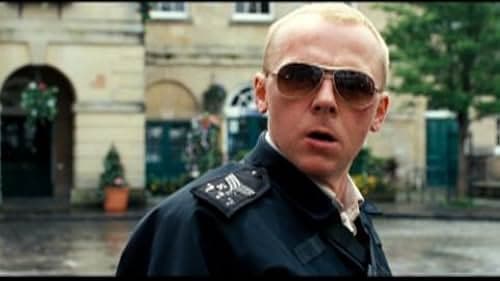
The opening montage introducing Officer Nicholas Angel functions almost like a compressed parody of every hyper-efficient action hero introduction from late twentieth-century cop cinema.
The sequence begins deceptively slowly.
Simon Pegg walks directly toward the camera while the sound design isolates only his footsteps. The framing initially resembles the introduction of a dangerous antihero in a serious crime thriller.
Wright allows the shot enough compositional weight that the audience instinctively prepares for importance.
Then the montage explodes.
The scene fractures into an aggressive chain of hard-cut close-ups and extreme close-ups:
- Angel’s badge,
- police files,
- paperwork,
- athletic records,
- weapon qualifications,
- cycling achievements,
- riot-control certifications.
The editing rhythm becomes absurdly fast, with shots lasting mere seconds before instantly colliding into another image.
Importantly, Wright refuses to allow shots to breathe spatially.
Everything feels compressed.
Weaponized.
Accelerated.
The Comedy of Seriousness
This creates what critics often describe as a speed-up montage, a technique Wright repeatedly deploys throughout his filmography.
The montage compresses narrative information while simultaneously exaggerating the cinematic importance of trivial details.
The comedy emerges through tonal contradiction.
The narrator speaks with total seriousness, describing Angel’s “exceptional aptitude” as though introducing the protagonist of a Michael Mann crime thriller.
Yet the details become increasingly ridiculous.
The montage climaxes with the revelation that Angel’s latest line-of-duty injury involved being stabbed in the hand by a man dressed as Father Christmas.
What makes the sequence work is that Wright never visually “winks” at the audience.
The editing remains fully committed to the aesthetic grammar of action cinema.
The soundtrack intensifies procedural seriousness. The cuts remain dramatic. The rhythm stays aggressive.
The visual language validates Angel’s mythologized competence even while the content quietly undermines it.
And this is where Hot Fuzz differs from weaker parody films.
Wright does not merely reference genre conventions.
He reconstructs them formally.
Masculinity as Editing Rhythm
The opening montage also reveals Wright’s fascination with procedural fetishization.
Action cinema often romanticizes efficiency itself:
- loading weapons,
- checking equipment,
- opening car doors,
- putting on sunglasses,
- filing reports.
These actions receive exaggerated dramatic weight through editing and sound design.
Wright pushes this tendency toward absurd extremes.
Even paperwork receives action-movie editing.
In many ways, the opening sequence becomes less about Nicholas Angel as a person and more about the cinematic construction of masculine hypercompetence itself.
Angel barely feels human initially.
He feels edited.
And that observation becomes crucial later because the film gradually dismantles that image.
Beneath the procedural perfection lies someone emotionally isolated and psychologically incapable of functioning outside systems of work and discipline.
The Transfer Montage and Emotional Exile
The transfer montage from London to Sandford shifts the editing style significantly and demonstrates Wright’s tonal flexibility.
Unlike the opening montage — which weaponizes editing for ironic heroic intensity — the transfer sequence uses montage to produce melancholy displacement while still preserving comic self-awareness.
The sequence begins with Angel holding a peace lily before transitioning into a chain of centered shots involving:
- taxis,
- trains,
- luggage,
- rain,
- station signs,
- changing locations.
Wright continues using hard cuts and rapid transitions, but the emotional effect changes entirely.
One especially effective technique is the repeated use of black-screen transitions that create a blinking rhythm between shots.
The montage feels mechanical.
Almost assembly-line-like.
As though Angel himself is being processed out of one world and inserted unwillingly into another.
Speed Does Not Determine Tone
What makes the sequence fascinating is that the editing pace remains fast.
Yet emotionally, the sequence feels subdued.
This reveals something important:
editing speed alone does not determine tone.
The emotional register changes because of the surrounding cinematic context.
The acoustic music swells gradually rather than aggressively. Rain dominates the atmosphere. Angel’s face becomes increasingly expressionless as London disappears behind him.
The montage simultaneously communicates sincerity and irony.
On one level, the sequence genuinely portrays emotional exile. London represents:
- procedural purpose,
- velocity,
- competence,
- identity.
Sandford appears visually softer, slower, emptier, emotionally anticlimactic.
Yet Wright still frames this relocation with exaggerated cinematic seriousness.
The dramatic train sounds. The rain-soaked transitions. The isolated close-ups.
Everything inflates relocation to a quiet village into the emotional equivalent of a disgraced detective banished to the edge of civilization.
And beneath the joke, there is genuine sadness.
Spatial Isolation and Symmetry
The sequence also reveals Wright’s remarkable understanding of spatial editing.
Almost every frame positions Angel centrally within the composition.
The symmetry traps him mechanically inside the frame itself.
He appears increasingly disconnected from his environments, reinforcing the emotional isolation that defines his character early in the film.
Throughout Hot Fuzz, Wright repeatedly transforms ordinary actions into spectacles through montage:
- paperwork becomes militarized,
- loading weapons becomes ritual,
- location transitions become dramatic escalation.
This editing strategy serves two functions simultaneously.
First, it satirizes the excessive self-seriousness of action cinema by inflating insignificant moments into cinematic events.
Second, it reveals how deeply audiences have internalized the visual grammar of genre filmmaking itself.
We instinctively understand these editing rhythms because action cinema has conditioned us emotionally through repetition.
Wright weaponizes that familiarity for comedy.
Loving the Genre Too Much to Mock It Lazily
Yet the film never collapses into cynicism because Wright’s affection for the genre remains visible constantly.
The references are not dismissive.
They are deeply knowledgeable reconstructions of cinematic language itself.
The film mocks clichés while simultaneously delivering the pleasures associated with them.
That balance is extremely difficult.
Many parody films fail because they stand outside the genre laughing at it.
Hot Fuzz works because Edgar Wright stands inside the genre lovingly overclocking it until its absurdity becomes visible.
Cinema as Rhythm Before Punchline
In the end, the editing in Hot Fuzz does far more than maintain pace or generate humor.
It becomes the film’s central expressive system.
Through rapid montage, tonal collision, exaggerated compression, and procedural fetishization, Wright transforms editing into both satire and emotional storytelling.
The result is a film where:
- paperwork feels like combat,
- relocation feels like existential exile,
- and every hard cut arrives with the confidence of a filmmaker who understands something essential:
cinema itself can be funny long before a punchline arrives.
---
# Works Cited
Hot Fuzz. Directed by Edgar Wright, performances by Simon Pegg and Nick Frost, Working Title Films, 2007.
“The Editing Style of Edgar Wright.” Cinema Blography, http://www.cinemablography.org/blog/the-editing-style-of-edgar-wright
“Hot Fuzz.” Wikipedia, https://en.wikipedia.org/wiki/Hot_Fuzz
Synaptic connections
Backlinks
This node currently sits alone in the archive.
Related reading
Nearby essays
Casablanca, Ideology, and the Politics of Desire
Casablanca survives not because it is merely romantic, but because it understood how cinema could reorganize emotion during moments of political uncertainty. Beneath the smoke and sacrifice lies a film negotiating masculinity, ideology, nationalism, and desire.
Separation Beyond Divorce: Moral Fragmentation and Social Anxiety in A Separation
A Separation is not merely a film about divorce. It is a film about the impossibility of moral purity within systems built upon pressure, silence, class anxiety, and emotional compromise.
12 Angry Men and the Slow Collapse of Certainty
12 Angry Men is not simply a courtroom drama. It is a study of how ego, bias, masculinity, and emotional projection infect systems that pretend to operate on reason alone.
If this resonated
Join the archive.
New essays, recent fragments, and what I am reading or watching, sent only when there is something worth sending.
Join archive