Offside: Realism, Restriction, and the Politics of Seeing
Jafar Panahi transforms exclusion, waiting, and ordinary bureaucracy into one of cinema’s quietest and most devastating political critiques.
# Offside: Realism, Restriction, and the Politics of Seeing
Offside appears deceptively simple on the surface.
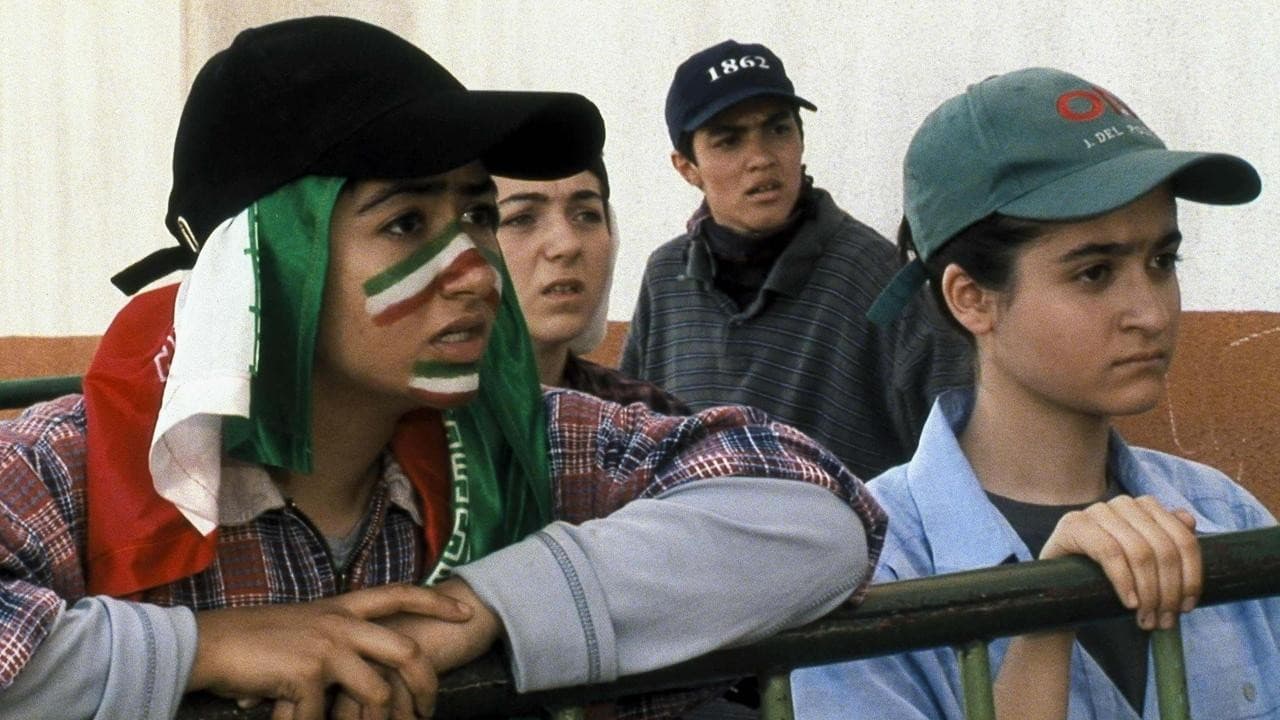
A group of girls attempt to enter a football stadium in Iran disguised as men because women are prohibited from attending the match. Most of the film unfolds outside the stadium itself, where the girls are detained behind barricades by young soldiers who are barely more authoritative than they are.
Yet from this small premise, Jafar Panahi constructs a quietly devastating critique of:
- bureaucracy,
- nationalism,
- gender restriction,
- surveillance,
- and the absurdity of authoritarian logic.
What makes Offside particularly fascinating is the way Panahi deploys elements of Italian Neorealism and Iranian New Wave realism not simply as aesthetic choices, but as political necessities.
The realism in the film is ideological.
It strips away cinematic excess so social reality can emerge without protective distance.
Realism Without Spectacle
Like the films of Vittorio De Sica or Roberto Rossellini, Offside constructs drama not through elaborate plot twists, but through ordinary social obstacles.
The film’s realism emerges through:
- duration,
- unpredictability,
- restricted movement,
- ordinary conversation,
- and the constant sensation that life continues beyond the frame.
Panahi does not portray Iran as abstract political metaphor alone.
He presents it as lived environment: contradictory, frustrating, funny, crowded, exhausting, and deeply human.
Space, Restriction, and Exclusion
One of the clearest neorealist elements in Offside lies in its use of real locations and restricted mise-en-scène.
Most of the film unfolds within spaces naturally associated with public sporting events:
- buses,
- barricades,
- military checkpoints,
- holding areas,
- crowded roads,
- stadium exteriors.
There are no elaborate sets or stylized cinematic environments.
The world feels materially inhabited rather than artificially designed.
And this spatial authenticity becomes essential because exclusion itself operates spatially throughout the film.
The girls are physically denied access to the match.
Panahi mirrors this exclusion formally.
The audience rarely sees the football game directly.
Instead, we hear:
- crowd chants,
- distant commentary,
- explosions of celebration,
- stadium announcements.
In many ways, the audience experiences the match exactly as the girls do:
indirectly, through fragments, through obstruction.
This becomes one of the film’s smartest formal decisions.
Football itself gradually becomes less important than the structures determining who is allowed to participate publicly.
Ordinary Duration and Narrative Realism
Panahi also embraces one of the central principles of Italian Neorealism:
the prioritization of ordinary duration over engineered narrative momentum.
Many scenes revolve around interactions conventional screenwriting would normally eliminate:
- soldiers arguing casually,
- logistical confusion,
- bus-driver irritation,
- waiting,
- boredom,
- fragmented conversation.
At first glance, these moments may appear narratively unnecessary.
But this is precisely where realism emerges.
Life rarely organizes itself around dramatic efficiency.
People become distracted. Systems malfunction. Conversations drift unexpectedly.
Panahi allows these moments to breathe because they create the sensation that the world exists independently of narrative convenience.
This observational approach aligns strongly with Iranian New Wave traditions where realism often emerges through witnessing rather than dramatic manipulation.
The camera behaves less like a controlling storyteller and more like a participant navigating unstable public space.
Obstructed Vision and Cinematic Restriction
The camerawork reinforces this observational realism constantly.
Panahi frequently employs handheld tracking shots following characters through moving crowds and unstable environments.
Unlike classical Hollywood cinematography — which privileges clean visual orientation and compositional mastery — Offside repeatedly allows the frame to become obstructed by:
- fences,
- soldiers,
- passing bodies,
- crowds,
- barriers.
These visual obstructions matter enormously.
The girls’ vision is constantly restricted by the state.
The camera mirrors this limitation formally.
Soldiers repeatedly interrupt the frame. Crowds block visibility. Barriers divide cinematic space physically.
The audience is denied stable visual control over the environment.
This connects strongly to realist film theory, especially the work of André Bazin.
Bazin argued that realism often emerges through:
- spatial continuity,
- ambiguity,
- duration,
- and resistance to excessive editing manipulation.
Panahi’s long takes, handheld framing, and deep-space compositions preserve uncertainty rather than reducing experience into neat dramatic clarity.
Spatial Oppression and Bureaucratic Violence
The framing itself frequently appears intentionally awkward.
Panahi shifts between:
- wide high-angle shots where characters disappear into crowds,
- and claustrophobic close framings inside buses or holding spaces.
During these confined sequences, the visual pressure becomes almost tactile.
The audience feels:
- heat,
- discomfort,
- restricted movement,
- lack of air,
- exhaustion.
One especially effective example occurs during the bus sequences where cramped framing and unstable camera movement produce overwhelming spatial suffocation.
The girls are not imprisoned violently.
They are spatially contained through ordinary bureaucratic systems.
And this banality becomes terrifying.
Authoritarianism in Offside does not appear through spectacular fascist imagery.
It appears through procedure.
Through ordinary people enforcing irrational rules mechanically.
Humanizing the System
One of Panahi’s greatest achievements is his refusal to simplify the soldiers themselves into purely villainous figures.
The young men guarding the girls often appear:
- awkward,
- embarrassed,
- sympathetic,
- confused,
- emotionally exhausted.
Some joke nervously. Others admit the absurdity of the rules they enforce.
This ambiguity becomes central to neorealist ethics.
Italian Neorealism frequently rejected simplistic moral binaries in favor of structural critique.
Panahi follows a similar path.
The problem in Offside is not merely individual cruelty.
It is systemic irrationality.
The barricade where the girls remain trapped becomes one of the film’s most effective pieces of mise-en-scène.
Literally positioned against walls and separated from the stadium, they visually embody exclusion itself.
They are expected to feel patriotic toward a nation simultaneously denying them full participation in public life.
Sound, Real Time, and Documentary Immediacy
The film’s temporal structure further intensifies realism.
The narrative unfolds almost entirely in real time surrounding a single football match.
This compressed duration immerses the audience directly into waiting, uncertainty, boredom, and emotional fluctuation alongside the characters themselves.
Even scenes appearing “irrelevant” contribute psychologically to temporal realism.
The sound design becomes equally important.
Panahi avoids non-diegetic music almost entirely.
All sound emerges from within the world itself:
- traffic,
- radios,
- fireworks,
- crowd chants,
- buses,
- footsteps,
- shouting,
- stadium announcements.
This absence of manipulative scoring produces almost documentary-like immediacy.
Without emotional cueing from orchestral music, the audience must navigate emotional meaning independently.
And that restraint becomes deeply powerful.
Fragile Solidarity
Near the conclusion, Iran wins the football match and celebration erupts throughout the city.
For a brief moment, barriers dissolve partially.
Soldiers and girls move together through public celebration.
Yet even this sequence avoids triumphant resolution.
The unity feels temporary. Fragile. Conditional.
Panahi refuses false catharsis.
The system itself remains unchanged.
And this reflects one of realism’s deepest insights:
life rarely resolves ideological contradictions cleanly.
Systems persist. Inequality remains. Small solidarities emerge and disappear within larger structures of power.
The Horror of Procedure
Ultimately, Offside demonstrates why realism was the perfect cinematic language for the story Panahi wanted to tell.
A heavily stylized or melodramatic approach would have weakened the film’s political force because the oppression depicted here is not fantastical enough to belong to spectacle.
Its horror lies precisely in how ordinary it feels.
The girls are not facing monsters.
They are facing procedure.
And Panahi understands something profoundly important:
realism becomes politically powerful when cinema stops exaggerating reality and instead allows reality itself to reveal how quietly cruel certain systems already are.
---
# Works Cited
Bazin, André. What Is Cinema? Vol. 1, translated by Hugh Gray, University of California Press, 1967.
Offside. Directed by Jafar Panahi, Jafar Panahi Film Productions, 2006.
“Offside — Film Analysis.” Senses of Cinema, https://www.sensesofcinema.com/2007/cteq/offside/
“Jafar Panahi and Iranian Neorealism.” Bright Lights Film Journal, https://brightlightsfilm.com
Synaptic connections
Backlinks
This node currently sits alone in the archive.
Related reading
Nearby essays
Casablanca, Ideology, and the Politics of Desire
Casablanca survives not because it is merely romantic, but because it understood how cinema could reorganize emotion during moments of political uncertainty. Beneath the smoke and sacrifice lies a film negotiating masculinity, ideology, nationalism, and desire.
Separation Beyond Divorce: Moral Fragmentation and Social Anxiety in A Separation
A Separation is not merely a film about divorce. It is a film about the impossibility of moral purity within systems built upon pressure, silence, class anxiety, and emotional compromise.
12 Angry Men and the Slow Collapse of Certainty
12 Angry Men is not simply a courtroom drama. It is a study of how ego, bias, masculinity, and emotional projection infect systems that pretend to operate on reason alone.
If this resonated
Join the archive.
New essays, recent fragments, and what I am reading or watching, sent only when there is something worth sending.
Join archive