Rashomon: Light Through Trees, Performance Through Memory, and the Collapse of Objective Truth
Akira Kurosawa transforms fractured testimony into cinematic philosophy through light, movement, rhythm, and spatial instability.
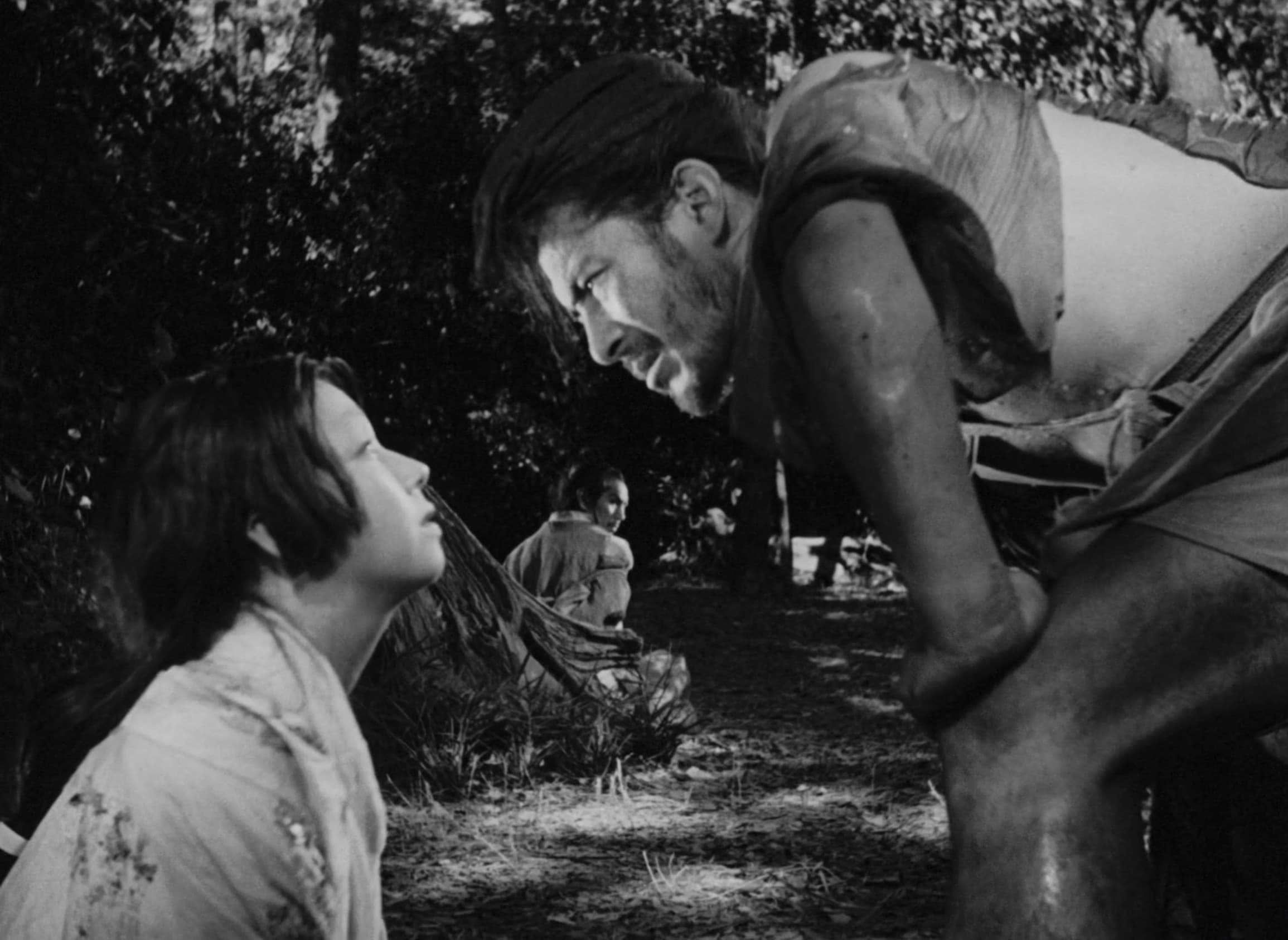
# Rashomon: Light Through Trees, Performance Through Memory, and the Collapse of Objective Truth
Rashomon is not merely a murder mystery or a courtroom drama disguised as a samurai film.
It is a film about the instability of truth itself.
More specifically, it is a film about the terrifying human tendency to aestheticize truth in order to protect the ego.
Every testimony in the film reshapes reality not according to what objectively happened, but according to how each character wishes to be remembered. In that sense, Rashomon is less interested in solving a crime than exposing the psychological theatre through which human beings narrativize themselves.
Postwar Collapse and Moral Fragmentation
Released in 1950 by Akira Kurosawa during postwar Japan, the film arrived in a historical moment where certainty itself had collapsed.
Japan had experienced military defeat, national humiliation, moral fragmentation, and ideological instability following World War II. Old social structures no longer carried unquestioned authority.
Rashomon channels this crisis directly into cinematic form.
The forest becomes a labyrinth of memory, morality, and self-deception where no perspective remains trustworthy for long.
The film would eventually give rise to what is now called the Rashomon Effect — contradictory interpretations of the same event.
But what makes the film revolutionary is that Kurosawa does not simply tell us truth is subjective.
He constructs subjectivity cinematically.
Through lighting, composition, editing rhythms, camera movement, and spatial organization, each testimony acquires its own emotional texture and moral logic.
Tajōmaru and the Performance of Masculinity
Among the testimonies presented in the film, the bandit Tajōmaru’s perspective remains the most stylistically fascinating because it transforms crime into heroic self-mythology.
In Tajōmaru’s version of events, Kurosawa employs:
- deep-space composition,
- dynamic tracking shots,
- rhythmic editing,
- subjective camera movement,
- and high-contrast lighting
to construct a cinematic fantasy where the bandit imagines himself not as a desperate criminal, but as a passionate warrior driven by masculinity, instinct, and destiny.
This becomes one of the film’s central insights:
human beings aestheticize themselves in memory.
The Ruined Gate and the Collapse of Certainty
The film begins not in certainty, but in collapse.
The Rashomon gate itself appears ruined, rain-drenched, and spiritually exhausted. The architecture mirrors the moral decay of the world the film inhabits.
Before the testimonies even begin, Kurosawa visually establishes fragmentation as the governing condition of the narrative.
And then comes the forest.
Light Through Trees
The introductory sequence involving the woodcutter remains one of the most influential uses of cinematography in film history.
Kurosawa shoots sunlight directly through dense tree branches using mirrors, creating the famous dappled-light effect known as komorebi.
The result is extraordinary.
Light itself appears fractured.
Instead of illuminating truth clearly, sunlight blinds, obscures, interrupts, and destabilizes vision.
This is not accidental realism.
The fragmented light becomes a visual metaphor for fragmented perception itself. Every image inside the forest exists between revelation and concealment.
Even nature refuses objectivity.
The woodcutter’s movement through the forest is captured through tracking shots alternating between frontal movement, rear movement, and lateral tracking. Kurosawa frequently positions the camera at face level, creating an uncanny intimacy between movement and spectator.
At other moments, the camera drifts silently behind him as though the forest itself is observing.
What makes these shots remarkable is their tactile density. Every branch, leaf, shadow, and movement feels overwhelmingly present.
The forest does not function as passive scenery.
It becomes psychologically oppressive.
The forest in Rashomon is not geography.
It is epistemology.
Style as Subjectivity
Once the film transitions into Tajōmaru’s testimony, however, the visual texture changes dramatically.
The forest no longer feels uncertain.
It becomes theatrical.
Unlike the woodcutter’s hesitant movement through space, Tajōmaru transforms the woods into a stage for masculine performance.
Even his courtroom behavior reveals this. The tribunal scenes consistently position characters gazing slightly above the camera, suggesting the invisible authority of institutional judgment.
Yet Tajōmaru behaves almost theatrically within this framework.
He laughs loudly. Stretches his body dramatically. Narrates events with exaggerated vitality.
Most importantly:
the cinematography validates his self-image.
One striking composition occurs when Tajōmaru first observes the couple beneath the trees. Kurosawa frames him partially obscured by shadow while the couple remain illuminated in the distance.
At first, the symbolism appears morally simple:
darkness surrounding criminality, light surrounding innocence.
But Kurosawa complicates this through deep-space composition.
The spatial distance transforms Tajōmaru into something almost mythological — a figure emerging from folklore rather than ordinary criminality.
The forest itself appears to produce him.
The Camera Participates in Fantasy
This is where Kurosawa’s use of deep space becomes crucial.
In the courtroom scenes, space remains comparatively flat and restrained.
Inside Tajōmaru’s memory, however, space becomes kinetic and expansive. Movement dominates the frame. The testimony therefore feels more cinematic than truthful.
Because Tajōmaru imagines himself heroically.
And this is perhaps the film’s most unsettling psychological insight:
human beings narrate themselves aesthetically before they narrate themselves honestly.
The camera movements reinforce this continuously. As Tajōmaru leads the samurai deeper into the forest, Kurosawa repeats tracking patterns previously associated with the woodcutter.
But the emotional effect changes completely.
The movement now feels predatory and controlled rather than uncertain.
The camera frequently tracks beside the bandit at eye level, aligning the spectator with his physicality and momentum.
The movement feels athletic. Fluid. Confident.
In many ways, the camera behaves as though it admires him.
And that is essential.
Kurosawa does not merely present contradictory testimonies.
He transforms cinematic style itself into psychological narration.
The Duel and the Destruction of Myth
The duel sequence demonstrates this perfectly.
In Tajōmaru’s testimony, the fight unfolds with aggressive rhythm and spatial clarity. Kurosawa uses:
- dynamic tracking shots,
- low-angle framings,
- rapid directional movement,
- choreographed camera rhythms
to transform violence into heroic spectacle.
One especially fascinating moment involves the camera circling around Tajōmaru while simultaneously following the husband’s nervous gaze.
The movement transforms Tajōmaru into force itself.
The camera does not merely record the duel.
It participates in Tajōmaru’s fantasy of dominance.
The editing rhythms support this interpretation. His account remains smooth, coherent, and visually controlled.
Memory itself becomes cinematic performance.
Truth Without Elegance
However, Kurosawa later dismantles this heroism through the woodcutter’s final testimony.
And suddenly, everything changes.
The graceful choreography disappears. The editing becomes fragmented. Movement loses rhythm. The fighters tremble visibly.
Instead of fearless warriors, we witness frightened men stumbling desperately through violence.
This contrast may be the film’s most devastating formal revelation.
Tajōmaru’s version resembles myth.
The woodcutter’s resembles embarrassment.
Kurosawa intentionally destroys the romanticism associated with masculine combat.
Even the cinematography collapses accordingly. The woodcutter’s account employs unstable framing, abrupt close-ups, fragmented continuity, and obstructed visual space.
The closer the film approaches truth, the less cinematic elegance remains.
And that is Kurosawa’s genius.
He suggests that human beings instinctively reshape memory into spectacle because reality itself is often humiliatingly banal.
Visibility and Uncertainty
Kurosawa’s lighting reinforces this instability constantly.
Faces remain interrupted by shadow, overexposure, and obstructive movement. Unlike classical Hollywood lighting designed for clarity, Kurosawa weaponizes visibility itself.
The audience is allowed to see everything.
And understand nothing completely.
This ambiguity also reflects broader postwar anxieties. After the collapse of imperial ideology and wartime propaganda, objective truth itself appeared suspect within Japanese society.
Rashomon therefore functions not merely as psychological drama, but as philosophical modernism.
It questions whether human beings are even capable of narrating themselves honestly.
Compassion After Collapse
Yet despite the film’s cynicism about truth, Kurosawa does not leave the audience entirely in despair.
The abandoned baby at the conclusion becomes morally crucial.
The woodcutter’s eventual act of compassion introduces the possibility that ethical action may still matter even when objective certainty collapses.
The film ultimately suggests something deeply human:
while truth may remain unstable, responsibility cannot disappear alongside it.
That is why Rashomon still feels modern.
Not because it tells us people lie.
We already knew that.
The film endures because it understands something far more uncomfortable:
people lie most convincingly when they are trying to protect the story they tell themselves about who they are.
And Kurosawa, through movement, light, rhythm, and fragmented space, transforms that psychological truth into cinema itself.
---
# Works Cited
Rashomon. Directed by Akira Kurosawa, performances by Toshiro Mifune, Machiko Kyō, and Masayuki Mori, Daiei Film, 1950.
Redfern, Nick. “Film Style and Narration in Rashomon.” Journal of Japanese and Korean Cinema, vol. 6, no. 1, 2014.
Richie, Donald. The Films of Akira Kurosawa. 3rd ed., University of California Press, 1998.
Prince, Stephen. The Warrior’s Camera: The Cinema of Akira Kurosawa. Princeton University Press, 1991.
Criterion Collection. “The Rashomon Effect.” The Criterion Collection, https://www.criterion.com/current/posts/195-the-rashomon-effect
Synaptic connections
Backlinks
This node currently sits alone in the archive.
Related reading
Nearby essays
Casablanca, Ideology, and the Politics of Desire
Casablanca survives not because it is merely romantic, but because it understood how cinema could reorganize emotion during moments of political uncertainty. Beneath the smoke and sacrifice lies a film negotiating masculinity, ideology, nationalism, and desire.
Separation Beyond Divorce: Moral Fragmentation and Social Anxiety in A Separation
A Separation is not merely a film about divorce. It is a film about the impossibility of moral purity within systems built upon pressure, silence, class anxiety, and emotional compromise.
12 Angry Men and the Slow Collapse of Certainty
12 Angry Men is not simply a courtroom drama. It is a study of how ego, bias, masculinity, and emotional projection infect systems that pretend to operate on reason alone.
If this resonated
Join the archive.
New essays, recent fragments, and what I am reading or watching, sent only when there is something worth sending.
Join archive