Strike: Collision, Collective Bodies, and the Machinery of Oppression in Eisenstein’s Revolutionary Cinema
Sergei Eisenstein transforms montage into political confrontation, turning editing itself into revolutionary force.
# Strike: Collision, Collective Bodies, and the Machinery of Oppression in Eisenstein’s Revolutionary Cinema
Strike is not a subtle film.
And it was never trying to be.
Directed by Sergei Eisenstein during the early years of the Soviet Union, the film operates less like traditional narrative cinema and more like an ideological machine designed to provoke emotional and political awakening within the spectator.
Unlike classical Hollywood cinema — which typically conceals editing in order to preserve realism and continuity — Eisenstein wants the audience to feel the cuts.
He wants montage to strike the viewer psychologically, emotionally, and intellectually.
And that word strike becomes increasingly important as the film progresses.
At first, the title refers simply to the workers’ labor strike against exploitative factory conditions and bourgeois management.
But by the conclusion, the meaning mutates violently.
The workers initiate a strike.
The state responds with a strike of its own.
A retaliatory blow against collective resistance.
The film gradually transforms from labor drama into cinematic warfare.
Montage as Political Weapon
More importantly, Strike becomes one of the clearest demonstrations of Eisenstein’s theory of montage, particularly what he later termed intellectual montage.
Through collisions of images, rhythms, and symbolic associations, Eisenstein constructs political meaning not through dialogue or character psychology, but through editing itself.
The film asks viewers to stop watching cinema passively and start thinking through juxtaposition.
And nowhere is this clearer than the ending of Part 5: Provocation and the beginning of Part 6: Extermination, where police suppression escalates into massacre.
While the film deploys metric, rhythmic, tonal, and overtonal montage throughout its runtime, this sequence synthesizes all these forms into one devastating act of political accusation.
Eisenstein transforms editing into ideology.
Machines, Bodies, and Bourgeois Decay
Before the massacre sequence begins, Eisenstein establishes a visual world already saturated with corruption and grotesque excess.
Factory managers and shareholders are presented almost caricature-like:
- smoking cigars,
- overfed,
- emotionally detached,
- visually coded as embodiments of bourgeois decay.
Their offices sharply contrast with the kinetic industrial spaces occupied by the workers.
The factory itself is introduced through unstable, machine-like camera movement where the frame almost vibrates alongside industrial labor.
The workers appear absorbed into machinery itself.
Meanwhile, ownership remains insulated from bodily consequences.
One especially revealing sequence occurs when managers report to the director. Eisenstein rapidly juxtaposes shots of:
- a woman typing,
- a hand slamming against money,
- another woman fainting,
- office objects being packed away.
Individually, these images remain relatively ordinary.
Together, however, they generate meaning through collision.
And this is where Eisenstein radicalizes the insights of Soviet montage theory.
Kuleshov demonstrated that audiences psychologically construct meaning between adjacent images.
Eisenstein pushes this principle further.
He does not merely want emotional continuity.
He wants conceptual conflict.
Editing becomes dialectical.
One image collides against another until political meaning emerges from tension itself.
Manufactured Chaos
This logic reaches its most powerful form in the final massacre sequence.
The introduction of the “King’s Men” already establishes moral corruption visually. Their hideout contains dead cats hanging upside down by their tails — grotesque imagery so excessive it almost resembles German Expressionism.
Eisenstein does not present these figures as psychologically complex individuals.
They function as embodiments of state-sponsored decay.
The police then orchestrate the looting of an alcohol depot, deliberately manufacturing social chaos in order to justify violent suppression later.
This detail matters politically.
The state creates disorder.
Then punishes workers for the resulting instability.
And suddenly, the film stops feeling historically distant.
Rhythmic Montage and Sensory Assault
What follows remains one of the most astonishing uses of montage in silent cinema.
Explosions. Collapsing doors. Panicked crowds. Fire. Theft. Orchestral crescendos. Screaming civilians.
The editing rhythm accelerates alongside emotional intensity itself.
Here Eisenstein deploys rhythmic montage, where shot duration synchronizes with movement inside the frame.
But the sequence does not stop there.
The orchestral accompaniment layered against the visuals generates what Eisenstein later described as overtonal montage.
The emotional force emerges not from isolated shots, but from cumulative sensory pressure produced by rhythm, composition, movement, tonal atmosphere, and symbolic escalation operating simultaneously.
The viewer does not merely observe chaos intellectually.
The montage overwhelms the nervous system directly.
The Water Hose Becomes Ideology
Yet the sequence becomes truly radical through intellectual montage.
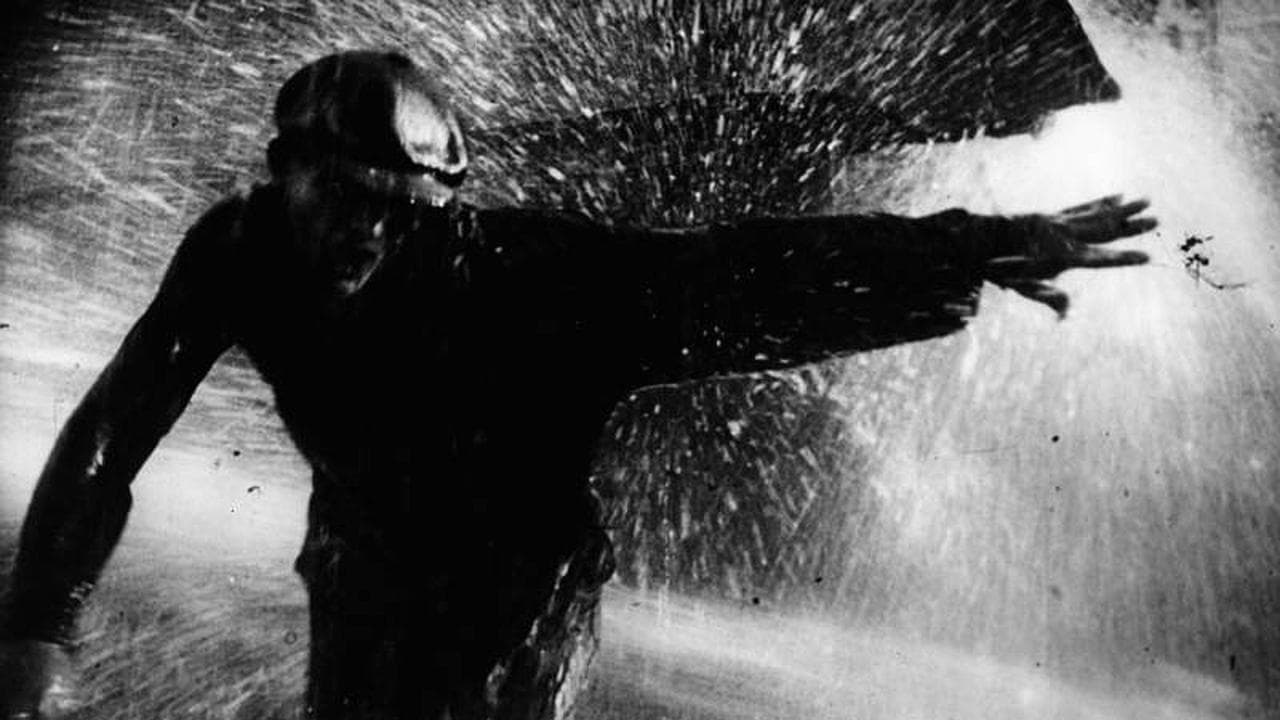
One striking moment occurs when the fire brigade uses water hoses to disperse protesting workers.
On a literal level, the hoses extinguish disorder.
Symbolically, however, the image functions much more deeply.
The water suppresses not merely physical flames, but revolutionary consciousness itself.
Political passion becomes metaphorically extinguished through state force.
This is where Eisenstein’s montage differs fundamentally from ordinary continuity editing.
Meaning does not reside within isolated images.
It emerges through conceptual relationships between images.
The water hose becomes ideology through montage.
Similarly, Eisenstein repeatedly cuts between bourgeois luxury and worker suffering throughout the film. While workers are beaten, starving, and hunted, the ruling class drinks comfortably and wipes dirt from their shoes using workers’ demands as paper.
Juxtaposition transforms cruelty into systemic indictment.
Collision and Collective Bodies
One of the film’s most devastating moments arrives during the massacre itself.
Workers are chased through apartments. Beaten in stairwells. Trampled in panic. Cornered like animals.
A mother screams while carrying her child. Men leap from heights in desperation. Collective resistance collapses gradually into survival instinct.
And then Eisenstein inserts the intertitle:
“Beasts.”
The placement of this single word retroactively transforms every preceding image.
The title does not merely describe violence.
It resolves the montage dialectically.
The state apparatus itself becomes animalistic.
Civilization reveals its barbaric core.
Academic discussions of Eisenstein frequently describe montage as collision, and nowhere is that more evident than here.
Images do not flow smoothly into one another like classical Hollywood editing.
They clash.
Attack.
Demand synthesis through contradiction.
The Proletariat as Protagonist
The massacre sequence also reveals Eisenstein’s rejection of traditional individual protagonists.
Unlike Hollywood cinema centered around singular heroes, Strike treats the proletariat itself as protagonist.
Faces emerge briefly through montage before dissolving back into collective movement.
The workers become a political body assembled through editing itself rather than psychological characterization.
This fundamentally shapes the film’s emotional experience.
When one child is thrown from a balcony by a policeman, the horror exceeds individual tragedy because Eisenstein immediately transforms the act into symbolic representation of systemic violence.
The child becomes more than character.
The image becomes accusation.
And this is perhaps Eisenstein’s greatest achievement:
he understood that cinema could produce ideology not only through narrative, but through form itself.
The editing rhythm teaches emotion. The collision of images teaches politics. The montage teaches historical consciousness.
Cinema as Revolution
Even today, the film feels astonishingly modern in its understanding of visual propaganda.
Contemporary political media constantly relies upon montage logic:
- juxtaposition,
- emotional escalation,
- symbolic condensation,
- visual shorthand.
Eisenstein simply recognized these mechanisms earlier and theorized them openly.
Yet despite its overt revolutionary purpose, Strike still survives as cinema because Eisenstein never abandons visual experimentation.
The grotesque caricatures. The rapid tonal shifts. The industrial imagery. The violent crescendos.
All possess almost operatic intensity.
Watching the film feels less like observing reality and more like being pulled into the machinery of ideology itself.
And perhaps that intensity explains why the film still matters beyond propaganda.
Many political films become historically obsolete once their ideological moment passes.
Strike endures because Eisenstein was not merely documenting class struggle.
He was reinventing cinematic language itself.
In the end, the massacre sequence demonstrates Eisenstein’s central insight perfectly:
cinema does not simply record reality.
Through montage, cinema can reorganize emotional perception, generate political meaning, and force audiences into intellectual confrontation with power.
The workers are beaten physically.
But the viewer is assaulted psychologically.
And somewhere between those collisions of images, Eisenstein transforms editing into revolution.
---
# Works Cited
Strike. Directed by Sergei Eisenstein, Goskino, 1925.
Eisenstein, Sergei. Film Form: Essays in Film Theory. Edited and translated by Jay Leyda, Harcourt, 1949.
Bordwell, David. The Cinema of Eisenstein. Harvard University Press, 1993.
“Strike (1925) Analysis and Background.” Cinema Monogatari, https://www.cinemamonogatari.com/2021/12/03/strike-1925-analysis-and-background/
“Review: Strike (1925).” Philosophy in Film, https://philosophyinfilm.com/2017/05/10/review-strike-1925/
Synaptic connections
Backlinks
This node currently sits alone in the archive.
Related reading
Nearby essays
Casablanca, Ideology, and the Politics of Desire
Casablanca survives not because it is merely romantic, but because it understood how cinema could reorganize emotion during moments of political uncertainty. Beneath the smoke and sacrifice lies a film negotiating masculinity, ideology, nationalism, and desire.
Separation Beyond Divorce: Moral Fragmentation and Social Anxiety in A Separation
A Separation is not merely a film about divorce. It is a film about the impossibility of moral purity within systems built upon pressure, silence, class anxiety, and emotional compromise.
12 Angry Men and the Slow Collapse of Certainty
12 Angry Men is not simply a courtroom drama. It is a study of how ego, bias, masculinity, and emotional projection infect systems that pretend to operate on reason alone.
If this resonated
Join the archive.
New essays, recent fragments, and what I am reading or watching, sent only when there is something worth sending.
Join archive