The Skin I Live In: Story, Plot, and the Horror of Reconstructed Identity
Pedro Almodóvar transforms bodily transformation into psychological horror through fragmented narrative structure and ethical instability.
# The Skin I Live In: Story, Plot, and the Horror of Reconstructed Identity
The Skin I Live In is a film where horror emerges not simply through violence, but through revelation.
Directed by Pedro Almodóvar, the film gradually transforms from mystery into psychological nightmare through the relationship between story and plot itself.
The distinction between those two concepts becomes crucial.
The story refers to the chronological sequence of events occurring within the world of the film.
The plot, however, concerns how those events are organized, concealed, delayed, and revealed to the audience.
And in The Skin I Live In, plot becomes the primary mechanism through which horror is generated.
The Body as Horror
The basic story of the film can initially be summarized relatively simply:
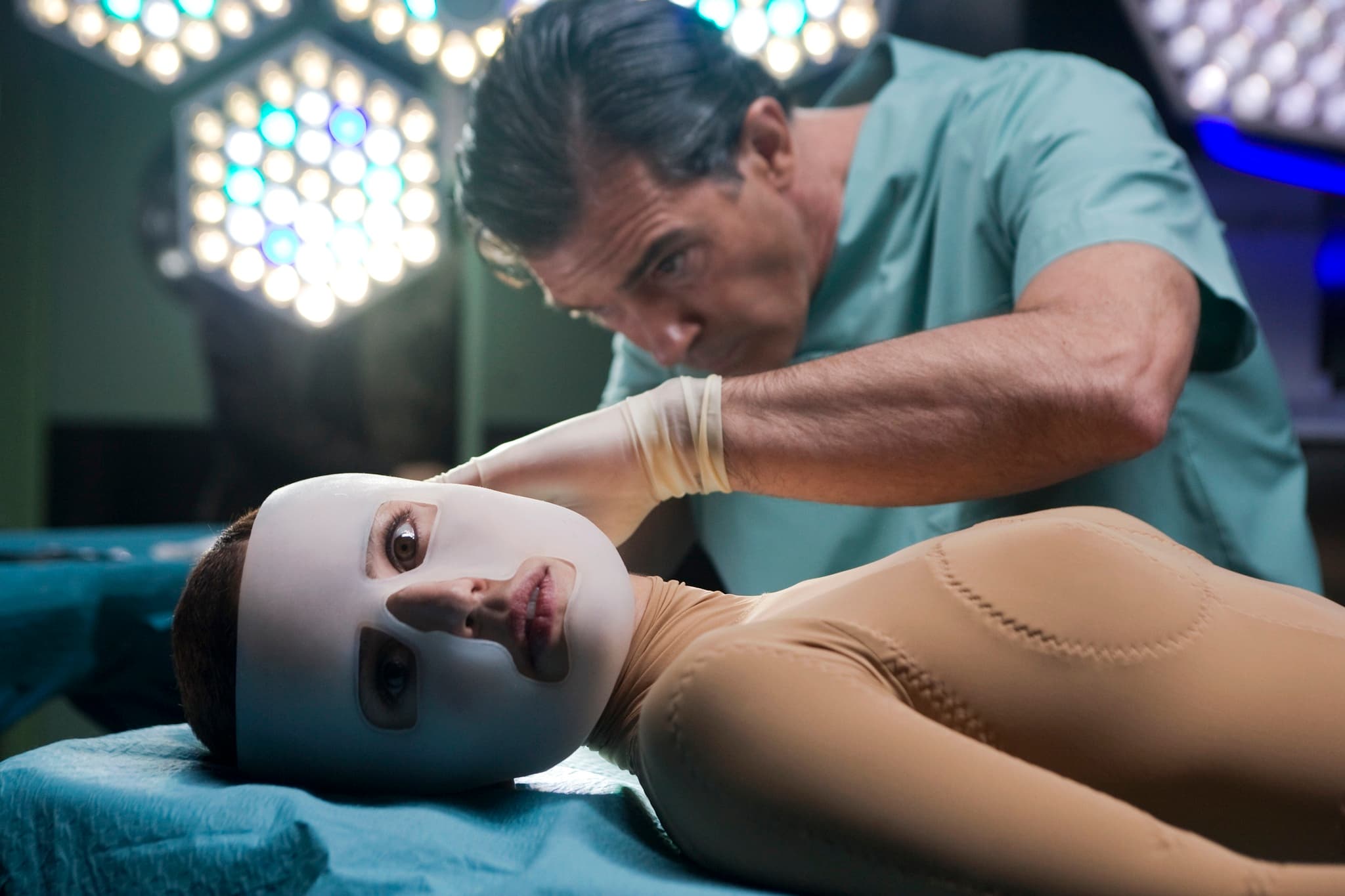
a wealthy plastic surgeon named Robert Ledgard keeps a mysterious woman imprisoned inside his home while conducting illicit medical experiments upon her.
The woman, Vera, is repeatedly shown wearing a body suit while Robert obsessively monitors her existence through surveillance systems and controlled confinement.
Eventually, we learn that Robert has developed an artificial skin through transgenesis using pig tissue.
However, the horror of the film does not emerge merely from scientific experimentation itself.
The body becomes a site of horror, mutation, and control.
This aligns the film strongly with traditions of body horror cinema where, as Laura Mulvey argues, horror emerges through "the spectacle of the body caught in processes of transformation."
Robert’s experiments become horrifying not simply because they are violent, but because they violate bodily autonomy itself.
The film destabilizes identity physically before it destabilizes it narratively.
Confinement, Trauma, and Narrative Delay
When Robert’s house is invaded by Zeca — the son of the family servant — the film intensifies its atmosphere of confinement and psychological instability.
Zeca rapes Vera before eventually being shot by Robert.
Up until this point, the narrative operates through deliberate uncertainty. The audience receives fragmented information without fully understanding the relationships connecting the characters.
Then the flashback structure begins reorganizing everything retroactively.
We discover that Zeca had been present years earlier when Robert’s wife, Gal, suffered a catastrophic car accident that left her body severely burned.
This backstory matters because it reveals how bodily trauma becomes the emotional origin of Robert’s obsession with reconstructive experimentation.
The Mirror and the Collapse of Identity
One of the film’s most psychologically devastating moments occurs when Gal, after months of medical treatment, hears her daughter singing outside.
As she approaches a mirror and sees her altered appearance reflected back at her, she panics and jumps to her death.
The mirror scene becomes extraordinarily important because the film repeatedly associates identity with visual recognition and bodily coherence.
In psychoanalytic terms, this evokes Jacques Lacan's theory of the mirror stage, where selfhood becomes dependent upon visual wholeness and recognition.
Gal’s inability to recognize herself transforms the mirror into an instrument of horror rather than self-confirmation.
The body no longer guarantees identity.
And that anxiety infects the entire film.
Vicente and Narrative Realignment
The narrative then introduces Vicente, a young man working in his mother’s dress shop.
From this point onward, the film quietly begins shifting audience alignment toward Vicente’s perspective, although the viewer does not yet fully understand why.
Vicente meets Robert’s daughter Norma at a wedding while both are under the influence of drugs.
As they begin becoming intimate in the garden, Norma experiences a psychotic episode triggered by the same song associated with her mother’s suicide.
Vicente attempts to calm her but accidentally knocks her unconscious while trying to restrain her.
Panicking, he redresses her and flees the scene.
Later, Robert discovers Norma unconscious and she mistakenly interprets her father as her attacker.
This trauma intensifies her androphobia — fear of men — eventually contributing to her suicide.
And this becomes the emotional rupture that drives the entire film.
Plot as Psychological Weapon
Robert tracks down Vicente and imprisons him inside his estate.
He performs non-consensual surgeries, vaginoplasty, hormonal alteration, and bodily reconstruction until Vicente is transformed physically into Vera — a replica of Robert’s dead wife.
This revelation radically restructures the viewer’s understanding of everything previously seen.
The audience initially believes Vera is simply a mysterious captive woman.
The flashback sequence violently reframes the entire narrative.
This is where Tzvetan Todorov's theories of narrative structure become especially useful.
Todorov argues that narratives function through movement from equilibrium toward disequilibrium before arriving at new understanding.
Almodóvar weaponizes delayed information itself.
The audience must retroactively reorganize every earlier scene after learning Vera’s true identity.
Plot therefore becomes a mechanism of horror.
The viewer experiences revelation almost as violation.
Alignment, Allegiance, and Ethical Instability
Throughout the first half of the film, the audience aligns primarily with Robert because he controls narrative perspective and screen authority.
This reflects David Bordwell's distinction between alignment and allegiance.
The film initially aligns viewers with Robert structurally through perspective and narrative access.
However, once Vicente’s transformation is revealed, allegiance shifts dramatically.
The audience now understands the horrifying extent of Robert’s actions.
And suddenly, earlier scenes acquire entirely different ethical meaning.
The horror of the film therefore emerges not solely from bodily mutilation, but from forced ethical reorientation itself.
The audience realizes they had unknowingly occupied the perspective of the monster.
Horror Through Spectatorship
This destabilization becomes one of the film’s most sophisticated achievements.
The plot manipulates not simply information, but spectatorship itself.
Robert initially appears tragic: a grieving husband attempting scientific transcendence.
Later, he becomes terrifying: a man reconstructing identity through patriarchal control, revenge, and bodily domination.
The audience’s emotional position collapses alongside the narrative.
And that collapse produces profound discomfort.
Vera and the Monstrous-Feminine
The conclusion intensifies this further.
Vera eventually kills Robert and the servant before escaping back to Vicente’s mother, who has spent six years searching for her missing son.
Yet the ending refuses emotional restoration.
Vicente survives physically.
But identity itself has been irreversibly violated.
The film offers no comforting return to normality.
This aligns closely with Sigmund Freud's famous argument that horror concerns "the return of the repressed."
The film represses anxieties surrounding:
- gender,
- bodily control,
- scientific domination,
- sexual violence,
- identity instability,
only to force them back onto the screen grotesquely.
Similarly, Barbara Creed's theory of the monstrous-feminine becomes deeply relevant.
Vera’s body is constructed through patriarchal violence and scientific control.
Femininity itself becomes artificial imposition.
The horror emerges because gender identity is shown not as natural essence, but as violently manufactured performance.
Story Duration, Plot Duration, Screen Duration
The film also manipulates cinematic time remarkably.
While the immediate story duration appears relatively short — perhaps one or two weeks — the plot duration spans decades.
The chain of events begins with:
- Gal’s accident,
- Norma’s trauma,
- Vicente’s abduction,
- years of bodily experimentation.
Yet all of this unfolds within less than two hours of screen duration.
This temporal fragmentation demonstrates how cinema reorganizes causality through plot structure rather than chronological storytelling.
The film withholds information strategically in order to generate suspense, ethical uncertainty, and psychological disorientation.
Faceless Paintings and Fragmented Humanity
Visual symbolism reinforces these ideas constantly.
Robert’s house contains paintings of faceless human figures suspended throughout the environment.
These images function as visual reminders of the film’s obsession with unstable identity and fragmented humanity.
The faceless bodies echo the film’s larger anxieties surrounding:
- transgenesis,
- forced transformation,
- sexual violence,
- bodily reconstruction,
- and psychological imprisonment.
Even architecture inside the house feels sterile, controlled, and emotionally detached.
The environment itself becomes surgical.
Horror as Identity Collapse
Ultimately, The Skin I Live In uses plot structure not merely to tell a story, but to produce horror through disorientation, ethical instability, and bodily violation.
The horror does not emerge solely from gore or violence.
It emerges gradually through realization.
The audience slowly understands that identity itself can be reconstructed, manipulated, imprisoned, and aesthetically redesigned by power.
And that possibility becomes far more disturbing than physical violence alone.
Because beneath the surgeries and scientific experimentation lies the film’s deepest terror:
the human body may not protect the self nearly as much as we want to believe.
---
# Works Cited
Creed, Barbara. The Monstrous-Feminine: Film, Feminism, Psychoanalysis. Routledge, 1993.
Lacan, Jacques. “The Mirror Stage as Formative of the I.” Écrits. Norton, 2006.
Smith, Murray. Engaging Characters: Fiction, Emotion, and the Cinema. Oxford University Press, 1995.
Todorov, Tzvetan. The Fantastic: A Structural Approach to a Literary Genre. Cornell University Press, 1975.
Williams, Linda. “Film Bodies: Gender, Genre, and Excess.” Film Quarterly, vol. 44, no. 4, 1991, pp. 2–13.
Wood, Robin. “An Introduction to the American Horror Film.” Robin Wood on the Horror Film: Collected Essays and Reviews, edited by Barry Keith Grant, Wayne State University Press, 2018, pp. 73–110.
Synaptic connections
Backlinks
This node currently sits alone in the archive.
Related reading
Nearby essays
Casablanca, Ideology, and the Politics of Desire
Casablanca survives not because it is merely romantic, but because it understood how cinema could reorganize emotion during moments of political uncertainty. Beneath the smoke and sacrifice lies a film negotiating masculinity, ideology, nationalism, and desire.
Separation Beyond Divorce: Moral Fragmentation and Social Anxiety in A Separation
A Separation is not merely a film about divorce. It is a film about the impossibility of moral purity within systems built upon pressure, silence, class anxiety, and emotional compromise.
12 Angry Men and the Slow Collapse of Certainty
12 Angry Men is not simply a courtroom drama. It is a study of how ego, bias, masculinity, and emotional projection infect systems that pretend to operate on reason alone.
If this resonated
Join the archive.
New essays, recent fragments, and what I am reading or watching, sent only when there is something worth sending.
Join archive