Us: Sound, Doubles, and the Horror Beneath the American Dream
Jordan Peele transforms mirrors, sound design, and visual doubles into a psychological and political nightmare about identity, repression, and America itself.
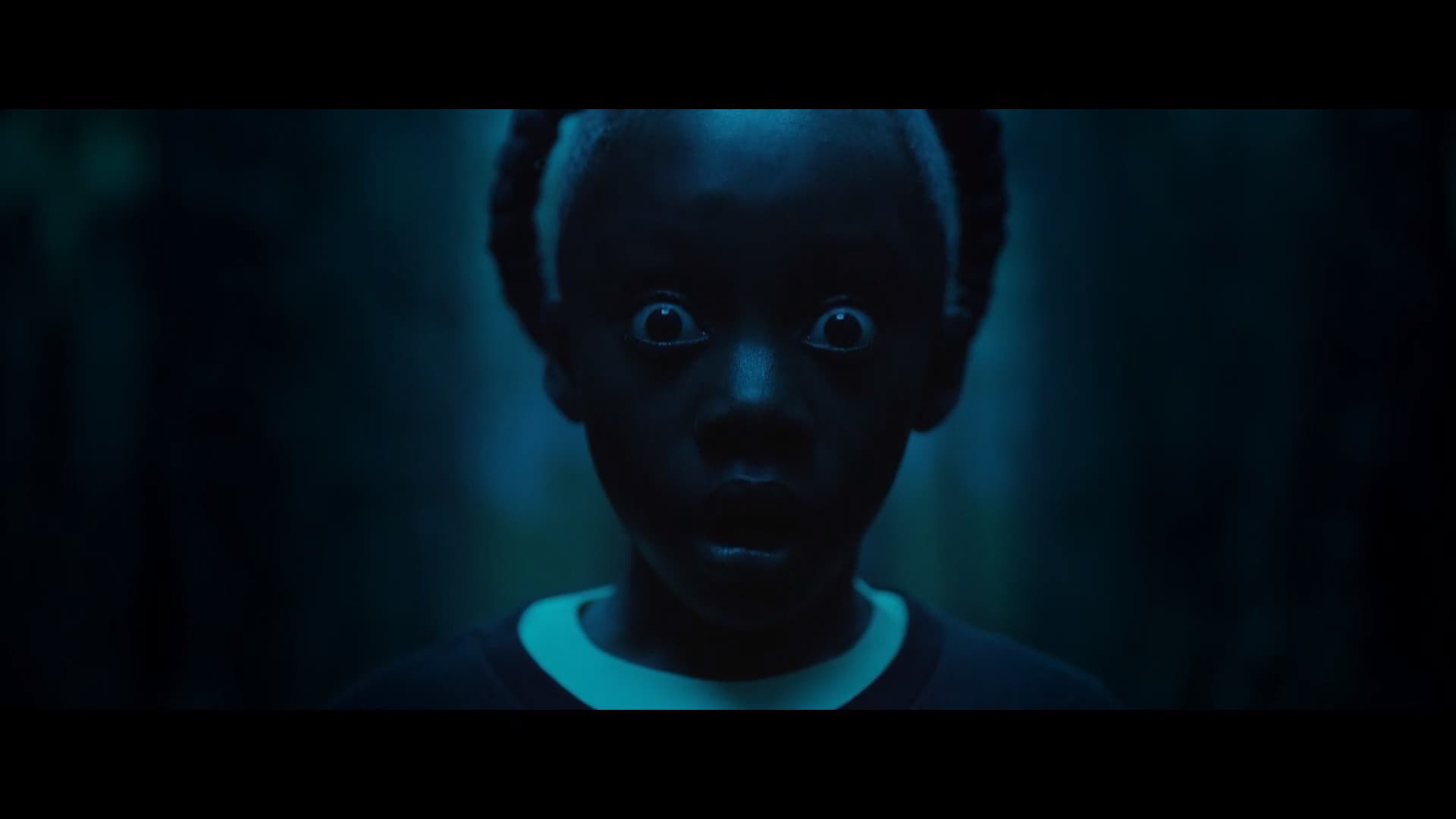
# Us: Sound, Doubles, and the Horror Beneath the American Dream
Us is a horror film obsessed with reflection.
Not simply literal mirrors, but psychological mirrors, social mirrors, national mirrors.
Directed by Jordan Peele, the film gradually reveals that its true horror does not emerge from monsters invading the home.
The horror emerges from the realization that the monsters were always connected to the home itself.
And Peele communicates this not only through narrative, but through formal cinematic techniques involving sound, lighting, framing, editing, and mise-en-scène.
Sound as Psychological Transition
One of the film’s most effective formal strategies is its manipulation of sound.
Initially, the film repeatedly prepares the audience for dread through transitions from ordinary diegetic sound into increasingly abstract non-diegetic soundscapes.
Two sequences demonstrate this especially clearly:
- Adelaide entering the house of mirrors as a child,
- and later when her son briefly disappears.
Both scenes begin with recognizable environmental sounds:
- rollercoasters,
- arguing couples,
- ocean waves,
- carnival noise,
- crowds,
- laughter.
Yet gradually these sounds begin fading into distant abstraction until only eerie acapella-like textures remain.
The audience is slowly removed from ordinary reality and pushed into psychological unease.
This transition becomes extremely effective because the movement from diegetic to non-diegetic sound mirrors Adelaide’s movement from reality into dread itself.
Sound design scholar Michel Chion argues that sound in cinema can "materialize fear" by shaping emotional expectation before visual confirmation appears.
Peele understands this perfectly.
The soundtrack often anticipates danger long before the audience consciously processes it visually.
The drowning-out of environmental sound creates isolation.
The viewer becomes trapped inside Adelaide’s subjective anxiety.
Jeremiah 11:11 and Apocalyptic Foreshadowing
The film also repeatedly uses symbolic mise-en-scène to generate subconscious tension.
One especially important image involves the homeless man holding a sign reading:
Jeremiah 11:11
The biblical verse warns that disaster will arrive and that cries for salvation will go unanswered.
This functions as far more than simple foreshadowing.
Biblical imagery has historically occupied a central role in horror cinema because it evokes:
- prophecy,
- punishment,
- guilt,
- apocalypse,
- moral reckoning.
Robin Wood argues that horror often externalizes cultural anxieties through symbolic figures and warnings.
The Jeremiah verse therefore operates both narratively and ideologically.
It suggests inevitability.
Something buried is already returning.
Restricted Vision and Subconscious Threat
Peele further creates anxiety through highly controlled framing and visual emphasis.
At one point, we receive sharply focused shots of pelicans gathering along the shore.
Pelicans usually gather when preparing to feed.
Soon afterward, the film cuts toward a man buried beneath sand with only his face exposed as he awakens.
These images remain unsettling partly because of how Peele frames them.
The audience’s field of vision becomes restricted.
Close framing narrows perception and unconsciously produces vulnerability.
Psychoanalytic film theory argues that horror often emerges from partial visual information and restricted knowledge.
By limiting what the audience fully perceives, Peele transforms ordinary objects into threatening presences.
The horror does not emerge solely from monsters.
It emerges from uncertainty itself.
Darkness and Moral Ambiguity
Lighting throughout Us also plays a major role in constructing emotional atmosphere.
Interior spaces frequently remain underlit, making it difficult to visually distinguish safety from threat.
Shadows dominate the frame.
And then suddenly, the red jumpsuits of the Tethered violently interrupt the darkness.
This contrast between blackness and red becomes visually symbolic.
Red functions simultaneously as:
- danger,
- violence,
- rage,
- revolution,
- buried trauma.
But more importantly, the lighting destabilizes moral clarity.
Peele refuses simplistic binaries between monster and victim.
The darkness itself becomes ethical ambiguity visualized.
The American Dream as Horror
This becomes especially important when considering the film’s political metaphor.
The Wilson family initially appears as a successful suburban Black family living comfortably inside the framework of the American dream.
That image matters.
Historically, Black Americans have been excluded from many structures of economic and social security associated with suburban prosperity.
Peele destabilizes this image deliberately.
The family’s comfortable home gradually transforms into a site of invasion and existential terror.
And beneath that invasion lies a larger implication:
even success cannot erase buried systemic violence.
The horror of Us emerges because the “American dream” itself appears built upon invisible repression.
“We Are Americans”
One of the film’s most important moments occurs when Adelaide asks her double who they are.
The response arrives simply:
“We are Americans.”
This line functions as the ideological center of the film.
The horror does not come from foreign monsters, demons, or supernatural outsiders.
It comes from the nation’s own hidden underclass.
Robin Wood famously described horror monsters as “the return of the repressed.”
Peele literalizes this concept through the Tethered themselves.
They are society’s discarded doubles.
Invisible lives buried beneath systems of privilege and comfort.
The title itself reinforces this politically.
The film is simultaneously about:
- us as collective humanity,
- and U.S. as the United States.
The horror therefore becomes national and psychological simultaneously.
Peele suggests that violence, exploitation, inequality, and paranoia are not external threats contaminating America.
They are embedded within its structure.
Freud and the Uncanny Double
This idea becomes psychologically devastating through the film’s use of doubles.
The Tethered are terrifying precisely because they are familiar.
Freud's concept of the uncanny becomes crucial here.
Freud argues that the uncanny emerges when something previously hidden suddenly returns in altered form.
The doppelganger becomes horrifying because it transforms the familiar into the threatening.
The Tethered are not strangers.
They are distorted reflections.
The self stripped of social illusion.
And that is why the film lingers psychologically.
The audience recognizes itself inside the horror.
Editing and Retroactive Horror
The film’s final reveal demonstrates Peele’s mastery of editing and narrative restructuring.
Toward the conclusion, we discover that Adelaide and her double had switched places years earlier inside the house of mirrors.
The “real” Adelaide had been imprisoned underground all along.
The editing during this reveal becomes especially effective because Peele crosscuts rhythmically between present events and childhood flashbacks, forcing the audience to reinterpret the entire narrative retroactively.
Earlier scenes acquire entirely different meaning.
The audience realizes it had unknowingly aligned itself with someone concealing monstrous truth.
And suddenly, identity itself becomes unstable.
Masks, Performance, and Monstrosity
The final exchange between Adelaide and her son intensifies this further.
Her son slowly pulls down his mask while Adelaide smirks toward him.
The gesture becomes symbolic.
Masks in the film are never merely physical objects.
They represent performed identity.
Throughout the narrative Adelaide appeared as protagonist, survivor, mother.
The ending reveals that she herself had always been hiding beneath constructed normality.
And this becomes the film’s deepest horror:
monstrosity and humanity may not be separable categories.
The self and the double become psychologically indistinguishable.
Horror Beneath the Reflection
Ultimately, Us uses sound, lighting, editing, framing, and symbolic doubling to construct horror not simply through violence, but through recognition.
The film repeatedly suggests that what society fears most may not be external invasion.
It may be confrontation with what has already been buried beneath ordinary life.
The Tethered are horrifying because they force the surface world to confront its own hidden foundations.
And somewhere between mirrors, shadows, distorted voices, and uncanny doubles, Peele transforms horror cinema into a reflection of America itself.
---
# Works Cited
Carroll, Noël. The Philosophy of Horror. Routledge, 1990.
Chion, Michel. Audio-Vision: Sound on Screen. Columbia University Press, 1994.
Freud, Sigmund. “The Uncanny.” The Standard Edition of the Complete Psychological Works of Sigmund Freud, vol. 17, Hogarth Press, 1955.
Wood, Robin. “An Introduction to the American Horror Film.” Robin Wood on the Horror Film: Collected Essays and Reviews, edited by Barry Keith Grant, Wayne State University Press, 2018, pp. 73–110.
Synaptic connections
Backlinks
This node currently sits alone in the archive.
Related reading
Nearby essays
Casablanca, Ideology, and the Politics of Desire
Casablanca survives not because it is merely romantic, but because it understood how cinema could reorganize emotion during moments of political uncertainty. Beneath the smoke and sacrifice lies a film negotiating masculinity, ideology, nationalism, and desire.
Separation Beyond Divorce: Moral Fragmentation and Social Anxiety in A Separation
A Separation is not merely a film about divorce. It is a film about the impossibility of moral purity within systems built upon pressure, silence, class anxiety, and emotional compromise.
12 Angry Men and the Slow Collapse of Certainty
12 Angry Men is not simply a courtroom drama. It is a study of how ego, bias, masculinity, and emotional projection infect systems that pretend to operate on reason alone.
If this resonated
Join the archive.
New essays, recent fragments, and what I am reading or watching, sent only when there is something worth sending.
Join archive