Dracula and the Gothic Unconscious
Blood, empire, sexuality, and why the vampire never stopped haunting modernity.
There are monsters that disappear with history, and there are monsters that evolve alongside it.
Dracula belongs to the second category.
More than a century after Bram Stoker published Dracula in 1897, the vampire continues to survive through cinema, literature, games, fashion, internet aesthetics, and popular culture. The figure mutates endlessly. Sometimes Dracula appears as a grotesque corpse spreading plague. Sometimes he is a seductive aristocrat. Sometimes a tragic romantic antihero. Sometimes an embodiment of disease, migration, addiction, loneliness, capitalism, sexuality, or immortality itself.
That adaptability is precisely why Dracula matters.
The vampire survives because it was never simply a creature of horror. It was a psychological and political technology through which societies encoded their anxieties about modernity, sexuality, empire, contamination, death, and the instability of identity itself.
The Gothic does not merely frighten us. It diagnoses civilizations.
The origins of the vampire
The vampire did not begin with elegance.
Long before capes, castles, and aristocratic seduction, vampire folklore emerged from premodern anxieties surrounding death, disease, and decomposition. Across Slavic and Eastern European traditions, vampires were not charming immortals but bloated, grotesque revenants associated with plague, improper burial rituals, and bodily corruption.
One of the most influential historical incidents was the case of Arnold Paole in 1726, a Serbian man believed to have returned from the dead as a vampire after his burial. Reports surrounding the case spread throughout Europe and helped solidify the vampire within Western imagination. These early vampires resembled what modern audiences might associate more closely with zombies or ghouls than with cinematic Dracula. They were decomposing bodies violating the natural boundary between life and death.
The fear surrounding vampires was fundamentally biological.
Diseases such as rabies, cholera, tuberculosis, and porphyria were often linked to vampirism. In premodern societies where medicine remained poorly understood, illness itself appeared supernatural. Bodies decayed mysteriously. Epidemics spread invisibly. Entire villages could collapse from contamination that no one understood.
The vampire therefore emerged as a symbolic explanation for invisible infection.
Even today, this logic persists. Horror repeatedly returns to contamination narratives because disease destabilizes one of civilization’s deepest assumptions: that the body belongs to the self and remains controllable.
The Gothic begins when that illusion collapses.
From corpse to aristocrat
The modern vampire truly begins not in folklore but in literature.
In the nineteenth century, writers transformed the vampire from a monstrous peasant corpse into a seductive aristocratic figure. This shift was crucial because it relocated horror from the graveyard into the social order itself.
The first major example appears in John Polidori's The Vampyre. Lord Ruthven is elegant, charismatic, sexually transgressive, and socially mobile. The monster can now pass among polite society. Horror no longer lives outside civilization. It wears civilization’s clothes.
This transition reflects a broader Gothic anxiety: the fear that corruption may already exist inside the structures of refinement, class, and power.
Later works expanded this idea further. Sheridan Le Fanu's Carmilla introduced themes of feminine desire, erotic repression, and lesbian sexuality into vampire mythology. The vampire increasingly became associated with forbidden intimacy and destabilized gender norms.
By the time Stoker writes Dracula in 1897, the vampire has become an incredibly dense symbolic figure:
- aristocrat,
- invader,
- sexual predator,
- disease carrier,
- immortal relic,
- and anti-modern phantom.
Dracula arrives precisely at the moment when Victorian modernity begins doubting itself.
Dracula and Victorian anxiety
To understand Dracula historically is to understand late Victorian Britain psychologically.
The British Empire was approaching the height of its territorial power, yet beneath this confidence existed profound anxiety. Industrialization had transformed social life. Urbanization intensified class instability. Immigration increased. Scientific developments challenged religion. New discussions around sexuality threatened Victorian moral structures.
The empire appeared globally dominant while privately terrified.
Dracula embodies this contradiction.
Stephen Arata famously argues that the novel reflects fears of “reverse colonization.” Instead of Britain conquering foreign territories, the foreign Other now invades Britain itself. Dracula travels from Eastern Europe into London, purchases English property, infiltrates British domestic life, and contaminates British bodies.
The fear is not simply military invasion. It is biological and cultural infiltration.
Dracula crosses borders with unnatural ease. He moves like contagion.
Victorian Britain feared degeneration:
- racial degeneration,
- moral degeneration,
- imperial decline,
- collapse of national purity.
Dracula becomes the nightmare that empire secretly produces for itself.
The irony is profound. The British Empire expanded globally through extraction, domination, and penetration into foreign lands. Dracula mirrors that same process back toward England. He colonizes bodies the way empire colonized territories.
The monster therefore becomes imperial anxiety returning home.
Blood, sexuality, and repression
If Dracula terrified Victorian society politically, he unsettled it sexually.
Much of the novel’s horror revolves around blood exchange, penetration, bodily invasion, and nocturnal intimacy. Vampirism functions as an unmistakably erotic metaphor.
Freud’s psychoanalytic theories become deeply useful here.
Freud argued that repression never destroys forbidden desire. It merely buries it beneath consciousness until it returns in distorted form. Horror cinema repeatedly stages this return of the repressed. The monster becomes externalized desire.
Dracula embodies precisely this structure.
Victorian society outwardly celebrated restraint, discipline, purity, and domestic morality. Yet beneath this surface existed profound sexual repression. Dracula disrupts this carefully controlled order through seduction and contamination.
Lucy Westenra represents one of the clearest examples.
Before vampirism, Lucy appears as the ideal Victorian woman:
- innocent,
- marriageable,
- passive,
- socially acceptable.
After Dracula’s influence, she becomes sexually assertive and predatory. Her transformation horrifies the male characters not simply because she becomes undead, but because she becomes liberated from patriarchal expectations.
The famous staking scene carries unmistakable sexual symbolism. Violence and eroticism collapse into one another.
The Gothic repeatedly reveals what society publicly denies.
Dracula therefore exposes Victorian sexuality not as stable morality, but as repression constantly threatening to rupture.
The uncanny and the vampire
Freud’s concept of the uncanny also illuminates Dracula powerfully.
The uncanny emerges when something deeply familiar becomes strangely alien. The vampire is terrifying precisely because it resembles life too closely. It is neither fully alive nor fully dead. It occupies an unstable ontological space.
Dracula is horrifying because he collapses boundaries:
- life and death,
- desire and violence,
- human and monster,
- civilization and savagery,
- modernity and ancient superstition.
The uncanny destabilizes reality itself.
This is why Gothic architecture matters so deeply in Dracula adaptations. Castles, corridors, mirrors, shadows, and staircases externalize psychological instability. Gothic space behaves like the unconscious mind: fragmented, hidden, irrational, haunted.
The vampire ultimately represents the return of everything civilization attempts to suppress: death, desire, decay, irrationality, and mortality itself.
Dracula and modernity
One of the great paradoxes of Dracula is that although the Count appears ancient, the novel itself is obsessed with modern technology.
The text contains:
- telegrams,
- typewriters,
- phonographs,
- blood transfusions,
- trains,
- maps,
- newspapers,
- bureaucratic information systems.
Dracula emerges during the rise of information modernity.
The protagonists attempt to defeat Dracula through systems of documentation and rational coordination. Knowledge becomes weaponized. The modern world increasingly believes that data and science can control reality.
Yet Dracula repeatedly escapes these systems.
Science alone proves insufficient.
Van Helsing succeeds because he combines modern medicine with folklore, religion, mythology, and irrational knowledge. This tension becomes central to Gothic modernity: the realization that rational civilization never fully eliminates the irrational.
Modernity remains haunted.
This remains true today.
Technological societies still produce supernatural anxieties: AI, digital ghosts, deepfakes, algorithmic surveillance, virtual identity fragmentation.
The Gothic never disappears because modernity itself continuously generates uncanniness.
Dracula in cinema
Cinema transformed Dracula from literature into myth.
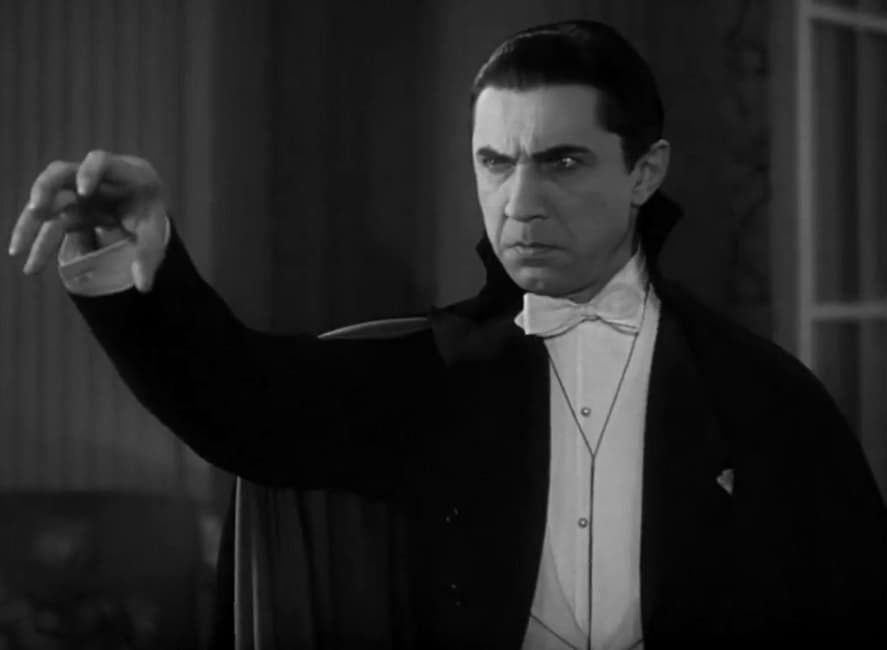
Perhaps the most influential adaptation remains the 1931 Dracula film starring Bela Lugosi. Lugosi's performance fundamentally shaped the cinematic vampire archetype: hypnotic voice, aristocratic elegance, controlled sensuality.
Importantly, this Dracula appears during the Great Depression. Horror films of the 1930s frequently reflected social instability and economic despair. The monster became a symbolic expression of collective anxiety.
At the same time, Dracula became eroticized.
Lugosi’s foreignness itself carried seductive danger. His accent, gaze, and mannerisms coded him as both desirable and threatening. The immigrant body became simultaneously fetishized and feared.
By contrast, F.W. Murnau's Nosferatu presents the vampire as pure plague imagery. Count Orlok resembles disease incarnate: rat-like, corpse-like, decaying.
German Expressionism transforms architecture into psychological nightmare. Shadows stretch unnaturally across walls. Space itself becomes infected.
Later adaptations radically reinvented Dracula again.
Francis Ford Coppola's Dracula reframed the Count as tragic romantic antihero. The vampire shifts from imperial invader into melancholic eternal lover.
This transformation reflects changing cultural anxieties.
Modern audiences increasingly romanticize monstrosity because contemporary culture often associates alienation itself with emotional authenticity. The lonely immortal becomes more relatable than the stable citizen.
The Gothic adapts to the emotional structure of each era.
Why Dracula never dies
Nina Auerbach famously wrote that:
“Every age embraces the vampire it needs.”
That may be the single best explanation for Dracula’s survival.
The vampire mutates historically because civilization’s fears mutate historically.
Victorian fears:
- empire,
- sexuality,
- degeneration.
Cold War fears:
- infiltration,
- ideological contamination.
AIDS-era fears:
- blood,
- infection,
- intimacy.
Contemporary fears:
- loneliness,
- technological alienation,
- simulation,
- immortality without meaning.
The vampire absorbs them all.
Dracula persists because the figure sits at the intersection of psychology, politics, and metaphysics. The vampire is simultaneously:
- predator,
- victim,
- aristocrat,
- exile,
- corpse,
- seducer,
- memory,
- and mirror.
The Gothic ultimately reveals something uncomfortable about civilization itself: human beings modernize technologically far faster than they evolve psychologically.
We build machines capable of simulating intelligence while remaining terrified of death, desire, loneliness, and decay.
The castle becomes the internet. The ghost becomes the algorithm. The vampire becomes the system that feeds endlessly on attention, labor, and identity.
The symbols change. The haunting remains.
Conclusion
Dracula survives because the vampire was never merely fictional. It was always social unconscious made visible.
Through Gothic horror, Victorian society confronted fears it could not openly articulate: sexual repression, imperial decline, disease, modern alienation, and the instability of civilized identity itself.
Cinema later transformed Dracula into one of modernity’s most adaptable symbolic figures. Each generation reinvents the vampire according to its own anxieties because the Gothic is fundamentally diagnostic. Horror does not simply entertain societies. It reveals what they are secretly afraid of becoming.
That is why Dracula still matters.
Not because we believe in vampires.
But because we still recognize ourselves inside them.
Works Cited
Arata, Stephen D. “The Occidental Tourist: Dracula and the Anxiety of Reverse Colonization.” Victorian Studies, vol. 33, no. 4, 1990, pp. 621–645.
Auerbach, Nina. Our Vampires, Ourselves. University of Chicago Press, 1995.
Freud, Sigmund. The Uncanny. 1919. Translated by David McLintock, Penguin Books, 2003.
Halberstam, Judith. Skin Shows: Gothic Horror and the Technology of Monsters. Duke University Press, 1995.
Senf, Carol. Dracula: Between Tradition and Modernism. Twayne Publishers, 1998.
Skal, David J. The Monster Show: A Cultural History of Horror. Faber and Faber, 1993.
Stoker, Bram. Dracula. 1897. Penguin Classics, 2003.
Related reading
Nearby essays
Casablanca, Ideology, and the Politics of Desire
Casablanca survives not because it is merely romantic, but because it understood how cinema could reorganize emotion during moments of political uncertainty. Beneath the smoke and sacrifice lies a film negotiating masculinity, ideology, nationalism, and desire.
Separation Beyond Divorce: Moral Fragmentation and Social Anxiety in A Separation
A Separation is not merely a film about divorce. It is a film about the impossibility of moral purity within systems built upon pressure, silence, class anxiety, and emotional compromise.
12 Angry Men and the Slow Collapse of Certainty
12 Angry Men is not simply a courtroom drama. It is a study of how ego, bias, masculinity, and emotional projection infect systems that pretend to operate on reason alone.
If this resonated
Join the archive.
New essays, recent fragments, and what I am reading or watching, sent only when there is something worth sending.
Join archive