Masculinity, Femininity, and Horror
The psychic collapse of normality and the gendered architecture of fear.
Horror is not simply a genre of monsters.
It is a genre of violated order.
Its central structure is almost always the same: a world presents itself as stable, ordinary, rational, domestic, or socially legible; then something returns that this world cannot contain. The monster, ghost, killer, curse, or possessed body becomes frightening because it breaks the symbolic agreements that make reality feel coherent.
Robin Wood’s influential theory of horror describes this conflict as a clash between “normality” and the Monster, where the monster represents everything society represses, excludes, or refuses to acknowledge. Horror therefore becomes one of the most powerful genres for examining gender because masculinity and femininity themselves are among the most heavily policed structures of social normality.
This essay argues that horror stages masculinity and femininity not as fixed biological truths, but as unstable symbolic positions inside culture and the psyche. Masculinity often appears in horror as control, surveillance, rational mastery, pursuit, and fear of vulnerability; femininity often appears as embodiment, receptivity, abjection, perception, and the threat of difference. Horror emerges when these roles collapse. The masculine subject confronts lack, castration anxiety, and loss of control, while the feminine figure becomes victim, monster, survivor, or psychic truth-teller. Horror rarely restores stable order. Instead, it reveals that “normality” was already unstable from the beginning.
Horror and the collapse of normality
Horror begins with disturbance.
A home is no longer safe. A body no longer obeys itself. A family hides violence beneath domestic respectability. A screen becomes haunted. A woman sees danger that society refuses to acknowledge.
In each case, horror transforms the familiar into the uncanny.
Sigmund Freud defines the uncanny as something once familiar returning in estranged form. Horror therefore feels intimate rather than purely external. It does not invent fear from nothing. It reveals fear already buried within ordinary life.
Normality in horror is therefore not innocence. It is repression.
Suburbia in Halloween appears calm, but Michael Myers reveals violence hidden beneath its surface. The family in Gothic fiction appears sacred, yet the haunted house exposes inheritance, secrecy, and trauma. Digital networks in films like The Ring appear connective and modern, yet reveal alienation and disappearance beneath technological progress.
Horror matters because it asks a dangerous question:
What must society repress in order to appear normal?
Masculinity and femininity as symbolic structures
Masculinity and femininity in horror should not be understood as fixed natural traits belonging biologically to men and women. Horror repeatedly demonstrates that gender operates symbolically and psychologically rather than essentially.
Masculinity, within patriarchal culture, is commonly associated with:
- control,
- rationality,
- mastery,
- hardness,
- emotional restraint,
- surveillance,
- authority,
- and protection.
But horror exposes how fragile this image truly is.
The masculine subject fears:
- dependency,
- emotional exposure,
- bodily vulnerability,
- passivity,
- and symbolic lack.
In psychoanalytic terms, masculinity becomes haunted by castration anxiety: not merely fear of literal injury, but fear of losing coherence, authority, and the fantasy of wholeness itself.
Femininity, by contrast, is culturally associated with:
- embodiment,
- receptivity,
- emotional openness,
- sexuality,
- maternity,
- vulnerability,
- and relationality.
Horror both exploits and destabilizes these associations.
Barbara Creed argues in The Monstrous-Feminine that horror repeatedly constructs femininity itself as terrifying through images of blood, reproduction, abjection, maternity, and bodily excess. The feminine becomes frightening because patriarchal culture fears what it cannot fully control.
Masculinity fears loss of control.
Femininity becomes horrifying because it reminds masculinity that control was never complete.
Castration anxiety and the masculine psyche
Castration anxiety becomes one of horror’s deepest psychological engines.
In Freud and later psychoanalytic film theory, castration anxiety refers to fear of symbolic loss: loss of mastery, loss of power, loss of identity, loss of coherent selfhood.
The masculine subject attempts to stabilize itself through systems of order: law, surveillance, rationality, control.
Horror dismantles these systems.
This is why the feminine body repeatedly becomes the site of horror. The feminine destabilizes masculine fantasies of completeness because it represents alterity, embodiment, and uncontrollable difference.
Laura Mulvey argues in "Visual Pleasure and Narrative Cinema" that classical cinema often structures women as objects of the male gaze while simultaneously positioning them as sources of anxiety because they signify sexual difference.
Horror intensifies this contradiction.
Barbara Creed reverses traditional Freudian assumptions by arguing that woman horrifies not because she is imagined as lacking, but because she is imagined as excessive, threatening, and potentially castrating.
This is why horror repeatedly returns to:
- witches,
- vampires,
- monstrous mothers,
- possessed girls,
- Final Girls,
- and female ghosts.
These figures disturb the fantasy that masculinity is sovereign.
The slasher and masculine pursuit
The slasher film gives this gendered structure remarkable clarity.
The killer often represents masculinity emptied of humanity and reduced to pure pursuit. Michael Myers in Halloween is not psychologically complex. He is a mask, a gaze, a compulsion moving through suburban space.
His masculinity is not strength. It is surveillance and repetition.
He watches. Follows. Invades. Returns.
The mask becomes important because it removes individuality and leaves only function. Masculinity appears not as emotional maturity but as deadened control.
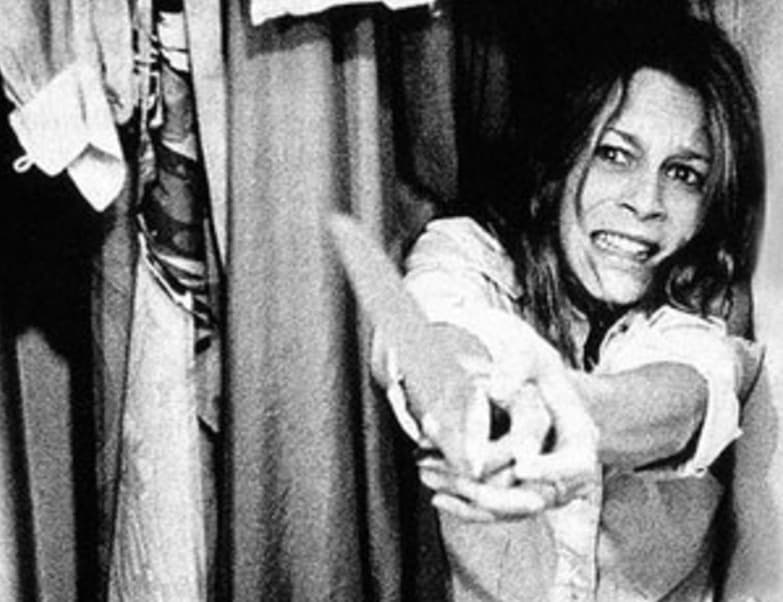
Laurie Strode survives not because she is physically dominant, but because she perceives danger before others do. Horror repeatedly gives women this psychic function: they register the breakdown of symbolic normality before society acknowledges it.
This is why the Final Girl matters psychologically.
Carol Clover argues that audience identification gradually shifts toward the surviving girl during slashers. Spectators do not simply consume female suffering voyeuristically. They are forced into her vulnerability, perception, terror, and resistance.
Gender therefore becomes unstable inside spectatorship itself.
The viewer moves psychologically between:
- victim,
- aggressor,
- observer,
- survivor,
- and monster.
Horror destabilizes fixed identity.
Femininity, abjection, and the body
Julia Kristeva’s concept of abjection becomes crucial here.
The abject is whatever disturbs boundaries:
- self and other,
- clean and unclean,
- living and dead,
- human and nonhuman.
Horror obsessively returns to these thresholds.
Bodies leak, transform, split, rot, bleed, mutate, or return from death.
The body becomes terrifying because it refuses symbolic mastery.
Creed applies this directly to the feminine body. Patriarchal horror frequently constructs femininity as abject because femininity remains culturally linked to reproduction, blood, maternity, and embodiment.
This does not mean femininity is inherently monstrous.
It means culture makes it monstrous because the feminine exposes the instability of masculine fantasies of control.
This is why body horror becomes philosophically important.
The body refuses ideology.
Masculinity wants transcendence: mind over flesh, reason over instinct, control over vulnerability.
Horror drags the subject back into embodiment.
The body becomes the truth ideology cannot fully suppress.
Gothic literature and gendered repression
These structures extend beyond cinema into Gothic literature.
In Dracula, masculinity fears feminine sexuality, foreign contamination, and collapse of patriarchal order. Lucy and Mina become sites upon which male anxiety is projected. Dracula himself becomes both hypermasculine predator and feminized foreign threat, crossing boundaries of nation, sexuality, body, and mortality.
In Frankenstein, Victor Frankenstein attempts masculine creation without femininity. He tries producing life without maternity, relationality, or care. The creature becomes the return of everything Victor represses: dependency, guilt, embodiment, and vulnerability.
The horror lies not simply in the creature’s existence.
The horror lies in masculine ambition refusing responsibility for what it creates.
Similarly, in Jane Eyre, Bertha Mason functions as the Gothic double of repressed feminine rage. She is imprisoned so respectable domestic order may continue uninterrupted.
But repression never remains stable.
The house eventually burns.
Across literature and cinema, horror repeatedly externalizes psychic conflict.
The monster becomes the psyche made visible.
What horror does to the spectator
When audiences watch horror, they do not merely observe fear.
They rehearse psychic breakdown from safe symbolic distance.
Barbara Mulvey describes horror as a "body genre" because it produces physical responses:
- tension,
- recoil,
- panic,
- trembling,
- shock.
Horror bypasses detached rationality and forces the body itself into participation.
This becomes important for gender because spectatorship itself destabilizes.
The viewer does not remain securely masculine, feminine, rational, or detached.
We fear with the victim. Watch through the killer’s gaze. Pity the monster. Become complicit in violence. Then suddenly recognize ourselves inside the monster.
Horror therefore reveals that identity itself is unstable.
The psyche engages horror because horror gives symbolic form to unspeakable anxieties:
- fear of death,
- fear of desire,
- fear of bodily collapse,
- fear of abandonment,
- fear of social breakdown,
- fear of exposure,
- fear of losing control.
The monster becomes the shape anxiety takes when language fails.
What horror actually resolves
Horror rarely resolves anxiety completely.
Even when the monster dies, something remains unfinished: the killer returns, the curse spreads, the ghost persists, the survivor remains traumatized.
This matters philosophically.
Horror’s resolution is not restoration of innocence. It is revelation.
The Final Girl survives because she confronts directly what the social order attempted to deny. Gothic narratives destroy houses and monsters, yet historical trauma remains unresolved. J-horror films frequently refuse closure altogether because technological alienation itself cannot be solved through narrative completion.
Horror therefore teaches that normality was never pure.
Masculinity was never invulnerable. Femininity was never passive. The monster was never fully outside us.
Conclusion
Horror is the genre of symbolic collapse.
It begins when normality is disrupted, but its deeper revelation is that normality was already built upon repression from the beginning. Masculinity and femininity in horror are not stable essences; they are psychic and cultural structures under pressure.
Masculinity fears:
- lack,
- dependency,
- emotional exposure,
- loss of mastery.
Femininity becomes culturally terrifying because it exposes:
- embodiment,
- abjection,
- desire,
- difference,
- and the instability of masculine control.
The Final Girl, the monstrous mother, the vampire, the possessed child, the ghost, and the masked killer all dramatize the same deeper truth:
horror is the psyche speaking through images.
We watch horror not merely to see monsters defeated, but to encounter what ordinary life attempts to hide. Horror reminds us that repression never truly disappears.
It waits.
And eventually, it returns.
Works Cited
Clover, Carol J. Men, Women, and Chain Saws: Gender in the Modern Horror Film. Princeton University Press, 1992.
Creed, Barbara. The Monstrous-Feminine: Film, Feminism, Psychoanalysis. Routledge, 1993.
Freud, Sigmund. The Uncanny. 1919. Penguin Books, 2003.
Kristeva, Julia. Powers of Horror: An Essay on Abjection. Columbia University Press, 1982.
Mulvey, Laura. “Visual Pleasure and Narrative Cinema.” Screen, vol. 16, no. 3, 1975, pp. 6–18.
Williams, Linda. “Film Bodies: Gender, Genre, and Excess.” Film Quarterly, vol. 44, no. 4, 1991, pp. 2–13.
Wood, Robin. Hollywood from Vietnam to Reagan. Columbia University Press, 2003.
Synaptic connections
Backlinks
Related reading
Nearby essays
Casablanca, Ideology, and the Politics of Desire
Casablanca survives not because it is merely romantic, but because it understood how cinema could reorganize emotion during moments of political uncertainty. Beneath the smoke and sacrifice lies a film negotiating masculinity, ideology, nationalism, and desire.
Separation Beyond Divorce: Moral Fragmentation and Social Anxiety in A Separation
A Separation is not merely a film about divorce. It is a film about the impossibility of moral purity within systems built upon pressure, silence, class anxiety, and emotional compromise.
12 Angry Men and the Slow Collapse of Certainty
12 Angry Men is not simply a courtroom drama. It is a study of how ego, bias, masculinity, and emotional projection infect systems that pretend to operate on reason alone.
If this resonated
Join the archive.
New essays, recent fragments, and what I am reading or watching, sent only when there is something worth sending.
Join archive